

POV in text means “point of view.” When someone types POV in a text message, tweet, or caption, they’re setting up a scene from a specific perspective, usually their own or an imagined one.
It’s less a grammar term and more a storytelling shortcut people use to pull you into a moment.
Quick Answer
POV stands for point of view. In texting and social media, it’s used to frame a situation as if the reader is experiencing it firsthand. Instead of describing what happened, the writer puts you inside the moment. “POV: you just got home and the WiFi is down” works better than a paragraph explaining the same annoyance.
What POV Actually Means in a Text Message
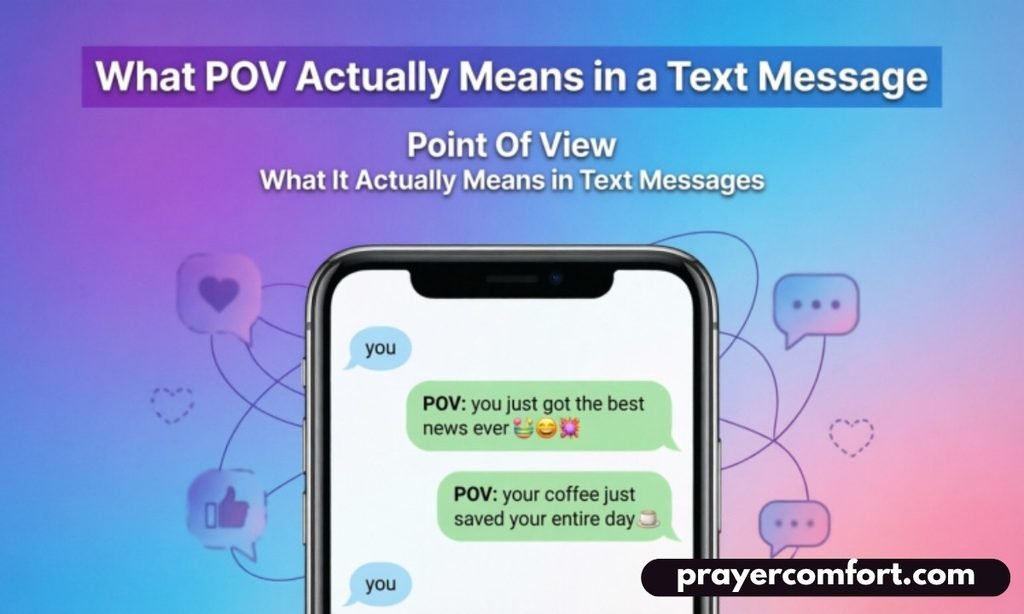
Point of view has been a literary term for centuries, but its use in texting is much newer and a lot more casual. When a friend texts “POV: we’re stuck in traffic again,” they’re not writing a novel excerpt. They’re compressing a whole scenario into a caption you can picture instantly.
The trick is that POV in text almost always implies you, the reader, are the main character. It’s second person by default, even when the words themselves don’t say “you.” That’s part of why it feels so immersive compared to a regular sentence.
This is different from how point of view works in fiction writing, where first person, second person, and third person are all formal narrative choices an author makes deliberately. Texting culture borrowed the term but stripped away the technical baggage. Nobody texting POV is thinking about narrative distance or unreliable narrators.
Read Meaning : What Does IDM Mean in Text
Where POV in Texting Came From
The honest answer is that nobody can point to one exact origin. Point of view as a concept has existed in writing and film for a long time, and the abbreviation POV was already common in gaming and video editing circles well before texting culture picked it up.
What seems to have happened is a gradual shift. People started using POV in video captions on platforms like TikTok and Vine before that, to signal “imagine this is happening to you.” From there it bled into regular texting and DMs because it was short, punchy, and instantly understood.
So while the exact first use is unclear, the pattern is familiar. Internet slang often starts in one corner of the internet, gets reused in short-form video, then spreads into everyday messaging once enough people recognize the format.
Read Meaning Slang : FT Meaning in Text
How POV Is Used Across Different Platforms
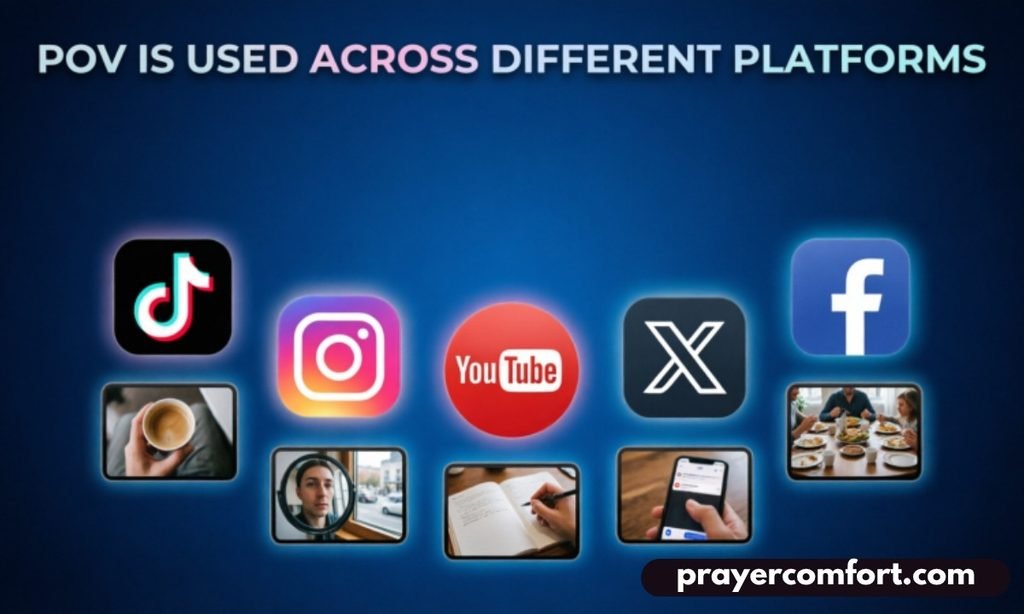
The core meaning stays the same everywhere, but the tone shifts a bit depending on where you see it.
In texting between friends
POV usually sets up something relatable or funny. It’s conversational and often self-deprecating, like poking fun at your own bad decisions or a shared inside joke.
On TikTok and Instagram Reels
POV videos are almost a genre of their own. Creators act out a scenario, and the caption tells you what role you’re supposed to imagine yourself in, like “POV: you’re the last customer before closing time.”
On Twitter or X
POV captions often pair with a screenshot or photo, letting the image do the storytelling while the text sets the scene.
In group chats
POV can get more sarcastic. People use it to exaggerate a mundane moment, turning something small into a dramatic bit for comedic effect.
Read Meaning Slang : TW Meaning in Text
Real Examples of POV in a Sentence
Seeing it in context makes the pattern click faster than any definition.
A friend sends a photo of an empty fridge with the caption “POV: payday is still four days away.” That’s the whole joke, no extra explanation needed.
Someone texts during a boring meeting: “POV: he’s been talking for 45 minutes and hasn’t said anything yet.” It reads like a complaint but lands as humor because you can picture it instantly.
A caption under a video of someone parallel parking badly: “POV: you told everyone you’re a great driver.” The gap between the claim and the video is where the humor comes from.
Even outside jokes, it shows up sincerely. “POV: your dog waiting by the door every day at 5pm” is just a warm, relatable moment, no punchline required.
When to Use POV and When to Skip It

POV works best when there’s a clear, visual scenario you want someone to step into. It’s built for moments, not explanations.
Use it when:
- You’re captioning a photo or short video with an implied scene
- You want to compress a relatable situation into one line
- The humor or emotion depends on the reader imagining themselves there
Skip it when:
- You’re giving straightforward information, like plans or logistics
- The context doesn’t actually have a visual or emotional “moment” to it
- You’re writing something formal, since POV reads as casual internet shorthand
Texting “POV: meeting moved to 3pm” doesn’t really work, because there’s no scene to picture. That’s a plain update, not a point of view.
Common Mistakes People Make With POV
The most common mix-up is using POV backward. It should describe what the reader is experiencing, not what the writer is doing to someone else. “POV: I’m ignoring my ex” is a little off, because it centers the writer instead of putting the reader in the scene. A cleaner version would flip it to the reader’s perspective, like “POV: your ex is watching you ignore them.”
Another mistake is overusing it for things that don’t need framing at all. Not every text needs a POV setup. If a sentence works fine on its own, tacking on POV just adds clutter.
People also sometimes confuse POV with just “in my opinion” or “personally.” Point of view in this slang sense isn’t about stating an opinion. It’s about staging a scene, which is a different function even though both involve perspective.
One nuance a lot of guides skip: POV texts almost never use past tense. It’s nearly always present tense, because the whole effect depends on making the moment feel like it’s happening right now, not something that already occurred.
Read Meaning : BTA Meaning Explained
Related Terms and Similar Slang
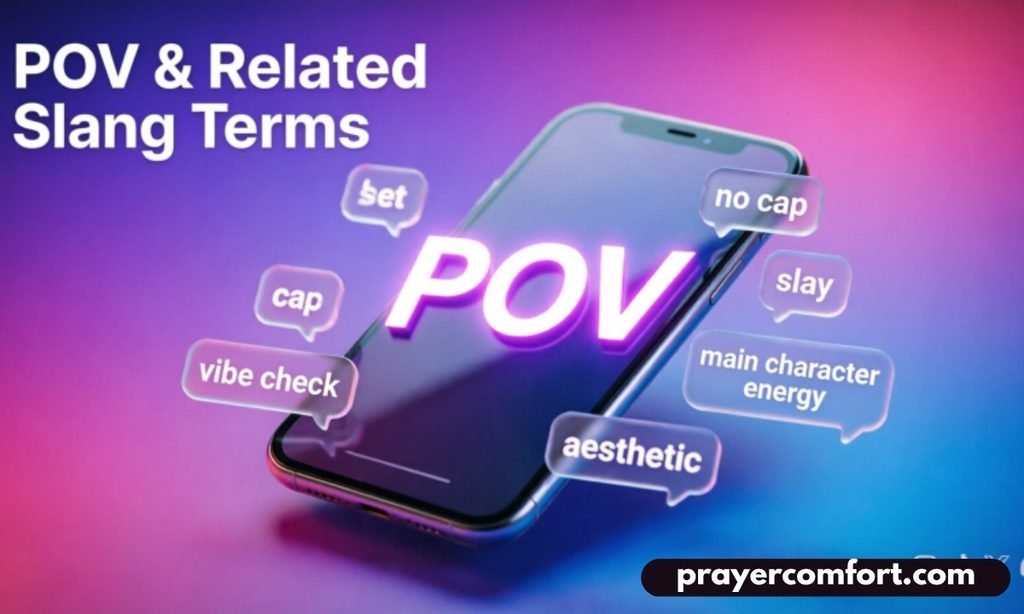
A few terms often show up alongside or get confused with POV in casual writing.
| Term | What It Means |
| FYP | For You Page, the TikTok algorithm feed, unrelated to perspective |
| IMO / IMHO | In my opinion / in my humble opinion, a stated view, not a scene |
| Vibe check | Assessing the mood of a moment, sometimes paired with POV captions |
| Main character energy | Acting like you’re the lead in your own story, thematically close to POV |
| First person / third person | The formal writing terms POV borrows from |
| Narrative perspective | The literary concept behind point of view in fiction |
Another Meaning Topic : What Does WYF Mean
Frequently Asked Questions
What does POV stand for in a text?
POV stands for point of view. In texting, it’s shorthand used to frame a message as a scene the reader is meant to imagine themselves inside, rather than just reading about it from a distance.
Is POV always used sarcastically?
No. POV is often used for humor or sarcasm, but it’s just as common for sincere, wholesome, or emotional moments. The tone depends entirely on the content that follows it, not the abbreviation itself.
Can POV be used in formal writing?
Not really. POV as slang belongs to casual texting and social media. In formal or academic writing, “point of view” would be spelled out fully and used in its traditional literary sense.
Does POV mean the same thing on TikTok as in a text?
Mostly yes, though on TikTok it’s often tied to an actual video performance, with someone acting out the scenario. In a plain text, it’s just words doing that same job without visuals.
Why do people say POV instead of just describing the scene?
It’s faster and it changes how the reader processes the message. A regular description keeps you as an observer, while POV nudges you to imagine being inside the moment, which tends to land as more relatable or funny.
Is POV grammatically correct to use in a sentence?
It functions more like a label than a grammatical part of the sentence, similar to how a caption works. It doesn’t need to follow standard sentence structure, which is part of why it reads naturally even as a sentence fragment.
Wrapping It Up
POV in text is really just a fast way to hand someone a scene instead of a summary. It borrows its name from film and literature but works on its own logic in texting, built for quick, relatable, present-tense moments.
Once you notice the pattern, it’s hard to miss how often it shows up, from group chat jokes to video captions. The best use of it is simple: if there’s a moment worth picturing, POV sets the scene in three letters.


2 thoughts on “POV Meaning in Text: The Clear & Powerful Guide 2k26”