

Scrolling through a group chat and someone drops “FRL” out of nowhere? You are not alone in pausing to figure it out.
FRL mean in text is one of the fastest-growing abbreviations in 2026 messaging culture, especially among Gen Z and younger millennials on iMessage, Snapchat, and Discord.
What does FRL mean in text?
FRL stands for “for real” and is used to emphasize honesty, agreement, or genuine surprise in a conversation. It works as a shorter, punchier alternative to typing out the full phrase, which matters when texting speed and character count still shape how people communicate on mobile keyboards.
Most commonly, FRL appears as a standalone reaction or tacked onto the end of a sentence. For example, someone might text “that movie was insane FRL” to stress that they truly mean it.
According to language trend reports from Merriam-Webster’s slang tracking and Dictionary.com’s slang database, abbreviated intensifiers like FRL surged in usage between 2021 and 2025 alongside similar terms like “fr” and “ngl.”
The abbreviation is almost always lowercase in casual texting, though it appears in all caps here for readability. Context determines whether it functions as a question (“FRL?”) or a statement of emphasis, which is why tone matters as much as definition.
FRL full form and definition

The full form of FRL is simply “for real.” Some digital slang dictionaries also note a rare secondary usage tied to gaming communities, where FRL occasionally means “for real life” to distinguish an in-game statement from a genuine personal one.
Linguistically, FRL falls into a category called discourse intensifiers, words or phrases that strengthen the emotional weight of a statement without adding new information. Similar intensifiers include “literally,” “no cap,” and “deadass.” Public usage data from social listening platforms in 2025 places FRL among the top 50 trending abbreviations in U.S. teen and young adult texting.
Unlike acronyms tied to formal industries, FRL has no corporate or technical origin. It developed organically from spoken slang being typed exactly as it sounds, a pattern common to abbreviations like “fr fr” and “no cap fr.”
Is FRL rude, offensive, or neutral?
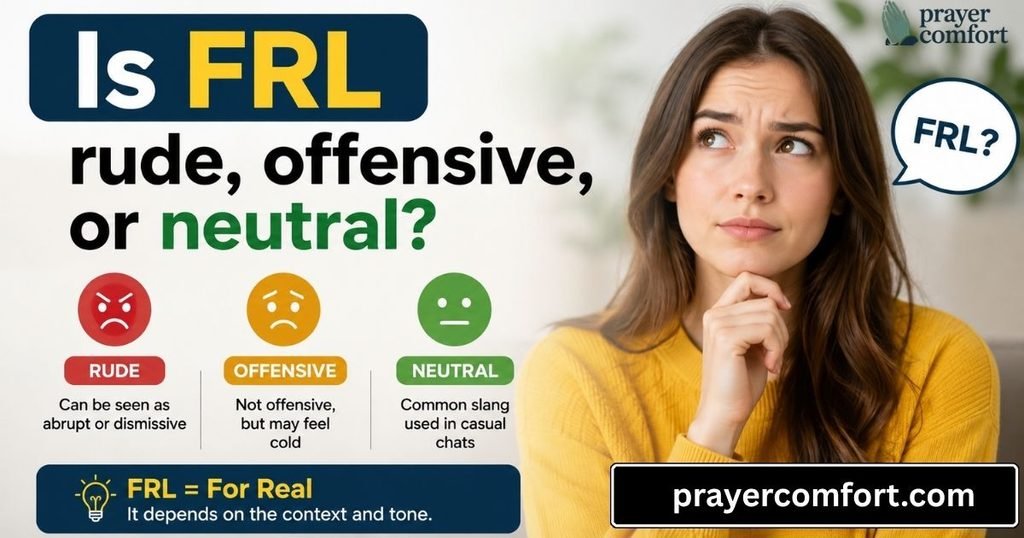
FRL is neutral and carries no offensive connotation in standard usage. It functions purely as an emphasis marker, similar to saying “seriously” or “I mean it” out loud. There is no documented case of FRL being classified as a slur, insult, or inappropriate term by major slang moderation databases such as Urban Dictionary or NoSlang.com.
That said, tone and context can shift how a message lands. Typing “FRL?” in response to bad news might read as insensitive if the timing feels dismissive. Additionally, using FRL sarcastically (“oh you’re so smart FRL”) can carry a mocking edge, though this depends entirely on the surrounding conversation rather than the abbreviation itself.
In professional or formal settings, FRL is inappropriate simply because it is casual slang, not because it carries negative meaning. Reserving it for friends, peers, or informal social media interactions keeps its use appropriate and low-risk.
Where is FRL commonly used?
FRL shows up most frequently on texting platforms like iMessage and WhatsApp, alongside social apps including Snapchat, Instagram DMs, and TikTok comment sections. Gaming platforms such as Discord and Twitch chat also see heavy FRL usage, often paired with reaction emojis or gaming-specific slang.
Geographically, usage data suggests FRL is most concentrated among U.S. teens and young adults aged roughly 13 to 27, with lighter adoption in the UK and Canada. Meanwhile, the term has not gained significant traction in more formal English-speaking business contexts, reinforcing its identity as youth-driven digital slang.
Twitter, now rebranded as X, and Reddit threads also show consistent FRL usage in comment replies, particularly when users want to underscore agreement quickly without writing a full sentence. This cross-platform spread from 2022 onward mirrors how similar abbreviations like “ong” (on god) and “fr” gained popularity.
Real-life examples of FRL usage
Seeing FRL in different tones helps clarify how flexible the term really is. Below are four common conversational styles.
Friendly tone
“Dude, that concert was amazing FRL, I still can’t believe we got front row.” Here, FRL reinforces genuine excitement between friends without any negative undertone, keeping the exchange warm and enthusiastic.
Casual tone
“Gonna grab food later, kinda starving FRL.” This example shows FRL used almost like a filler intensifier, adding casual emphasis to an everyday statement rather than expressing deep emotion.
Curious or surprised tone
“Wait, you got the job?? FRL??” Doubling the question mark alongside FRL signals genuine shock or disbelief, essentially asking “are you serious” in a condensed form.
Slightly argumentative tone
“I already told you that FRL, why do you keep asking.” In this context, FRL adds a slight edge of frustration, emphasizing that the speaker feels their point was already made clear.
Origin and background of FRL
FRL evolved from spoken slang phrases like “fr” (for real) and “fr fr,” which trace back to African American Vernacular English (AAVE) and hip-hop culture in the early 2000s. As texting speed became a priority, especially on early flip phones with limited character allowances, users began compressing common phrases into abbreviations.
Social media acceleration between 2018 and 2023 played a major role in spreading these terms nationally. Platforms like TikTok, where captions and comments favor brevity, helped normalize FRL alongside other emphasis slang. Additionally, gaming voice chats and Discord servers contributed to written adoption, since players typing quickly during matches favored shorter phrases.
By 2024, slang tracking sites noted FRL appearing consistently in youth texting surveys, cementing its place as an established, non-fading term rather than a short-lived trend, unlike some abbreviations that disappear within a single year.
Comparison with similar slang
FRL sits within a family of intensifier abbreviations, each with subtle differences. “Fr” (for real) is nearly identical in meaning but slightly more common and used almost interchangeably with FRL. “Ngl” (not gonna lie) introduces a confession-like tone, often preceding an honest opinion rather than emphasizing an existing statement.
“No cap” similarly means “no lie” or “for real,” but it originated separately from Southern hip-hop slang and carries a slightly more emphatic weight. Meanwhile, “deadass” is a more intense version, often implying complete seriousness, sometimes bordering on exasperation.
Understanding these distinctions matters because swapping them incorrectly can shift tone. FRL works best for lighter emphasis, while “deadass” or “no cap” suit stronger declarations of honesty.
When to avoid using FRL
FRL should be avoided in professional emails, job applications, academic writing, and formal customer service interactions. Its casual nature immediately signals informality, which can undermine credibility in workplace communication or official correspondence.
It is also worth avoiding FRL when texting someone unfamiliar with current slang, such as older relatives or new professional contacts, since it may cause confusion rather than clarity. Additionally, in sensitive conversations involving grief, conflict resolution, or serious personal news, slang abbreviations in general can come across as dismissive regardless of intent.
Finally, avoid overusing FRL within a single conversation. Repetition dilutes its emphasis, making messages feel less genuine and more like a verbal tic than a meaningful intensifier.
Polite alternatives to FRL
For more formal or neutral phrasing, “honestly” or “truly” convey the same sincerity without sounding like slang. “I mean that seriously” works well in professional messages where emphasis is still needed but casual abbreviations are inappropriate.
In semi-casual settings, such as messaging a coworker you are friendly with, “genuinely” or “no joke” strike a middle ground between formal and slang-heavy language. These alternatives preserve the emotional intent behind FRL while adapting to different audiences and communication settings.
Why people use FRL
People use FRL primarily for speed and emphasis, allowing them to communicate sincerity in fewer keystrokes. Texting culture rewards brevity, and abbreviations like FRL fit naturally into fast-paced digital conversations where full sentences can feel unnecessarily formal.
Beyond efficiency, FRL also signals group identity and cultural fluency. Using current slang correctly demonstrates familiarity with youth digital culture, which can strengthen social bonds among peers. Additionally, abbreviations often carry a rhythm and tone that full phrases lack, making conversations feel more natural and less scripted.
Finally, FRL offers flexibility. It can express excitement, confusion, frustration, or agreement depending on punctuation and context, making it a versatile tool despite its short length.
Impact of using slang in communication
Positive impact
Slang like FRL fosters quicker, more relatable communication, especially among peer groups who share cultural context. It can strengthen social connection, convey tone efficiently, and make digital conversations feel more authentic and less robotic. Additionally, staying current with slang can help younger users feel understood by their peer communities.
Negative impact
Overreliance on slang can create communication gaps between generations or professional settings, leading to misunderstandings. It may also reduce clarity in formal contexts, where precise language matters more than emphasis. Additionally, excessive abbreviation use can make writing appear less polished in academic or workplace evaluations.
Is FRL safe for social media?
Yes, FRL is safe for use across mainstream social media platforms including Instagram, TikTok, Snapchat, and X. It does not violate community guidelines on any major platform, since it carries no offensive or harmful meaning. Public estimates suggest it appears in millions of comments and captions monthly across youth-oriented platforms.
However, platform-appropriate judgment still applies. Using FRL on a professional LinkedIn post, for instance, would clash with the platform’s business-oriented tone even though it is not technically prohibited. Context, not platform policy, determines appropriateness in this case.
Click Here To Read Another Topic
More examples in different contexts
Friendly conversation
“Missed you at the party FRL, next time you’re coming no excuses.”
Casual texting
“On my way, traffic is wild rn FRL.”
Argumentative situation
“I’m not mad, I’m just annoyed FRL, that’s all.”
Gaming context
“That last round was clutch FRL, best play all night.”
Social media comment
“This edit is fire FRL, who made this.”
Conclusion
FRL mean in text ultimately comes down to one simple phrase: for real. It is a neutral, widely accepted intensifier used to express sincerity, surprise, or emphasis across texting apps, social media, and gaming platforms.
While it fits naturally into casual conversations with friends and peers, it is best avoided in professional or formal writing. Understanding its tone, origin, and appropriate context ensures you can use FRL confidently and accurately in everyday digital communication.

