
Typed “tommorrow” and then stared at it like it betrayed you? You’re not alone. This word trips up more people than almost any other in English, and autocorrect doesn’t always save you in time. The good news is the fix takes ten seconds to learn and sticks for life.
By the end of this article, you’ll never second-guess this word again, and you’ll actually understand why your fingers keep adding that extra “m” or “r” in the first place.
The Correct Spelling: “Tomorrow”
The correct spelling is tomorrow, spelled with one “m” and two “r’s”: t-o-m-o-r-r-o-w.
“Tommorrow” is a common misspelling, usually caused by double-typing the “m” instead of the “r.” There’s no version of this word with two m’s, no matter how natural it might feel to type it that way.
Here’s the simplest way to lock it in: one M, two R’s. That’s it. That’s the whole rule.
Why “Tommorrow” Is Incorrect
“Tommorrow” doesn’t follow any real English spelling pattern. It just feels right because of how our brains process double letters when we type fast.
Most double-letter mistakes happen because English is full of double consonants (letter, dinner, common), so people assume “tomorrow” needs one too. The problem is they double the wrong letter. The doubling in tomorrow happens on the “r,” not the “m.”
Think of it like reaching for the wrong key in a dark room. You know something needs to be doubled, your hand just grabs the nearest letter instead of the correct one.
Origin and Etymology of “Tomorrow”
Tomorrow comes from Middle English, formed by combining “to” and “morrow,” where morrow meant “morning” or “the next day.” Over time, “to morrow” merged into a single word.
This is actually why the spelling makes more sense once you see its roots. “To” contributes one letter (the single “o”), and “morrow” contributes its own doubled “r.” Nobody added an extra “m” at any point in history, which is exactly why “tommorrow” has never been correct in any era of English.
Older texts, including some biblical and historical English writings, even used “morrow” on its own to mean “the next day,” a usage that has mostly faded from modern speech but still shows up in phrases like “good morrow,” an old-fashioned greeting.
Knowing the word’s history isn’t just trivia. It’s the reason the spelling looks the way it does, and once you see the two building blocks (to + morrow), the correct form becomes almost impossible to forget.
Common Mistakes and Confusions
Besides “tommorrow,” people also type:
- Tomorow (missing the second “r”)
- Tomorow (missing an “r” entirely)
- Tommorow (wrong letter doubled, and still missing one)
- Tomorrow’s used incorrectly as a plural instead of a possessive
Most of these mistakes come from typing speed, not lack of vocabulary. People know how to say the word perfectly, their fingers just move faster than their spelling instincts.
There’s also a smaller but real confusion around whether tomorrow needs a capital letter. It doesn’t, unless it starts a sentence or appears in a title. It’s not a proper noun, so lowercase is correct in normal use (“I’ll call you tomorrow,” not “I’ll call you Tomorrow”).
Tomorrow what day
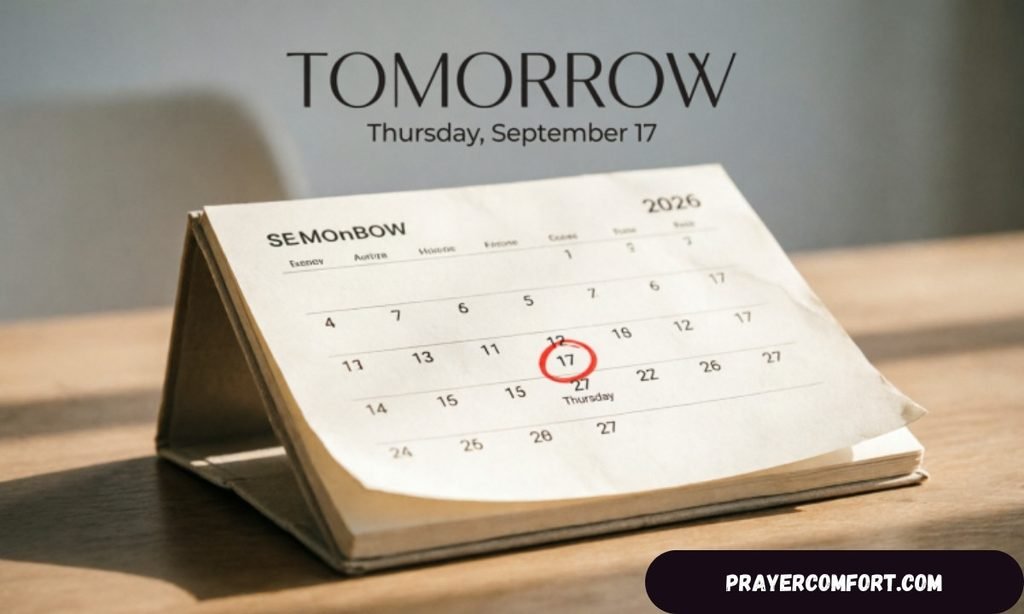
If today is Wednesday, tomorrow is Thursday. Tomorrow simply refers to the day immediately after today, whatever day that happens to be.
This sounds obvious, but it’s one of the most commonly searched phrases tied to this word, mostly because people use “tomorrow” in scheduling, texting, or planning and want a quick confirmation of the actual date or day of the week rather than the concept itself.
If you’re ever unsure, the fastest way to check is to look at today’s date on your phone or calendar and count forward one day. Digital calendars almost always label “tomorrow” automatically, which is a small but genuinely useful feature if you’re double-checking a deadline or appointment.
Memory Aids and Tricks for Correct Spelling
If you’ve misspelled this word before, you’re a perfect candidate for a memory trick. Here are four that actually work.
The Structural Split Method
Break the word into its two original pieces: TO + MORROW. Say them separately in your head. “To” plus “morrow” naturally gives you one “m” and two “r’s” without you even trying to memorize anything.
The Rhyme Trick
Use this short rhyme: “One M is fine, two R’s in a line.” It’s silly, but silly things stick better than serious rules, which is exactly why it works.
The Capitalization Trick
Visually separate the double letter in your head: to-MOR-row. Seeing the “MOR” chunk isolated helps your brain register that the doubling happens there, not at the start of the word.
The Phrase Anchor
Attach the spelling to a phrase you already know well, like “tomorrow morning.” Since “morning” also starts with “mor,” your brain links the two words and reinforces where the double letter actually belongs.
Tomorrow vs yesterday

Tomorrow and yesterday are opposite points in time relative to today. Tomorrow is the day after today, while yesterday is the day before today.
People often search this comparison when they’re trying to sort out verb tenses in a sentence, since tomorrow pairs with future tense (“I will go tomorrow”) and yesterday pairs with past tense (“I went yesterday”). Mixing these up is a common grammar slip, especially for English learners.
A quick way to remember the direction: yesterday looks back, tomorrow looks forward, and today sits right in the middle holding both hands.
Side-by-Side Comparison: Tomorrow vs Tommorrow
| Feature | Tomorrow (Correct) | Tommorrow (Incorrect) |
| Spelling | T-O-M-O-R-R-O-W | T-O-M-M-O-R-R-O-W |
| Letter count | 8 letters | 9 letters |
| Doubled letter | R | M (incorrectly doubled) |
| Dictionary status | Valid word | Not a real word |
| Origin | “to” + “morrow” | No etymological basis |
| Common cause | N/A | Fast typing, double-letter habit |
This table alone solves the confusion for most visual learners. One glance and the difference is obvious.
Real-World Usage Examples
Seeing the word in real sentences helps it settle into memory faster than any rule can.
- “The meeting is scheduled for tomorrow at 10 AM.”
- “She promised to send the report tomorrow morning.”
- “Tomorrow’s forecast calls for rain, so bring an umbrella.”
- “He’s flying out tomorrow evening for the conference.”
- “Don’t put off tomorrow what you can finish today.” (a twist on the classic saying)
Notice how “tomorrow” often pairs naturally with time markers like morning, evening, or a specific hour. That pattern itself can serve as a mental cue: if you’re talking about a future time, tomorrow is almost always nearby in the sentence.
| Don’t Miss These Articles |
| Buoy or Bouy? The Correct Spelling Revealed |
| Bellies or Bellys: Which Spelling Is Actually Correct? |
| RSVP Meaning: Discover What It Really Means |
Impacts of Incorrect Spelling
Misspelling “tomorrow” might seem small, but in professional and academic writing, it can quietly damage credibility.
In emails, resumes, or reports, a misspelled common word like “tommorrow” signals carelessness to the reader, even if the rest of the message is well written. Hiring managers and clients often judge attention to detail based on exactly these kinds of small errors.
In digital marketing and SEO, misspelled words in web copy can also hurt readability scores and trust signals, since polished, error-free content tends to rank and convert better than text riddled with typos.
The fix costs nothing. Getting it right, every time, takes less effort than the mistake itself.
Tomorrow spelling in british English

The spelling of “tomorrow” is identical in both American and British English. Unlike words such as “color/colour” or “realize/realise,” tomorrow doesn’t change across English dialects.
This makes it one of the more reliable words in English, at least spelling-wise. No matter which side of the Atlantic you’re writing for, one “m” and two “r’s” is always correct.
Pronunciation can vary slightly by accent, but the written form stays exactly the same everywhere English is spoken and written formally.
Auto-Correct and Spell-Check Limitations
Autocorrect catches “tommorrow” most of the time, but it isn’t flawless. On some devices, fast typing can create a different misspelling that autocorrect doesn’t recognize as an error, especially inside apps with weaker spell-check systems, like certain chat platforms or comment sections.
Autocorrect also can’t catch a spelling mistake if it accidentally creates another real word, though this is extremely rare with “tomorrow” since none of its common misspellings form actual English words.
The safest approach is still learning the spelling yourself rather than relying entirely on software, especially for handwritten notes, quick texts, or apps where spell-check is disabled.
Correct Usage in Context
“Tomorrow” functions as an adverb or a noun depending on the sentence.
As an adverb: “I’ll see you tomorrow.” (describes when the seeing happens)
As a noun: “Tomorrow is a new day.” (tomorrow itself is the subject)
It can also take a possessive form, as in “tomorrow’s weather,” which describes something belonging to or associated with the next day. It should never be written as “tomorrows” without the apostrophe when used possessively, since that creates a plural instead of showing ownership.
Practical Tips for Avoiding Mistakes
- Slow down slightly when typing the word, especially on mobile keyboards where double letters are easy to fumble
- Use the phrase “to + morrow” mentally before typing if you’re unsure
- Turn on spell-check in every writing app you regularly use, including messaging apps
- Proofread emails and documents specifically for common words, not just complex ones, since simple words get overlooked most often
- Read your sentence out loud, splitting the word into its two syllables, “to” and “morrow,” to reinforce the correct structure
Small habits like these prevent the mistake from happening in the first place, rather than fixing it after the fact.
Conclusion
“Tomorrow” is spelled with one “m” and two “r’s,” and “tommorrow” is simply a typing habit that never became a real word. Once you understand that the word comes from “to” plus “morrow,” the correct spelling stops being something you memorize and becomes something you just know.
Next time your fingers hesitate, remember: one M, two R’s, and you’re done.
FAQs
What is correct, tomorrow or tommorrow?
“Tomorrow” is the correct spelling. “Tommorrow” is a common misspelling and is not a recognized English word.
When to use tomorrow?
Use “tomorrow” when referring to the day right after today, either as a point in time (“I’ll finish it tomorrow”) or as the subject of a sentence (“Tomorrow looks busy”).
Is it correct to say “tomorrow”?
Yes, “tomorrow” is grammatically correct and widely used in both spoken and written English, functioning as either an adverb or a noun depending on context.
Why do we say “tomorrow” instead of “morrow”?
“Morrow” was the original Middle English word for “the next day,” and over time it combined with “to” to form “tomorrow.” “Morrow” still exists in English but is now considered old-fashioned and mostly appears in historical or literary writing.

Ethan is a passionate content creator and SEO specialist with 2 years of hands-on experience in crafting compelling digital narratives.A peaceful space to find daily prayers, uplifting blessings, and spiritual inspiration to brighten your life.
