

If you’ve typed this word and then stared at it wondering whether you added one too many (or too few) L’s, you’re not alone. Here’s the short answer: cancellation, with two L’s, is the correct and standard spelling in both American and British English.
Cancelation, with one L, is technically recognized by some dictionaries, but it’s rarely used and can look like a typo to most readers.
The Direct Answer
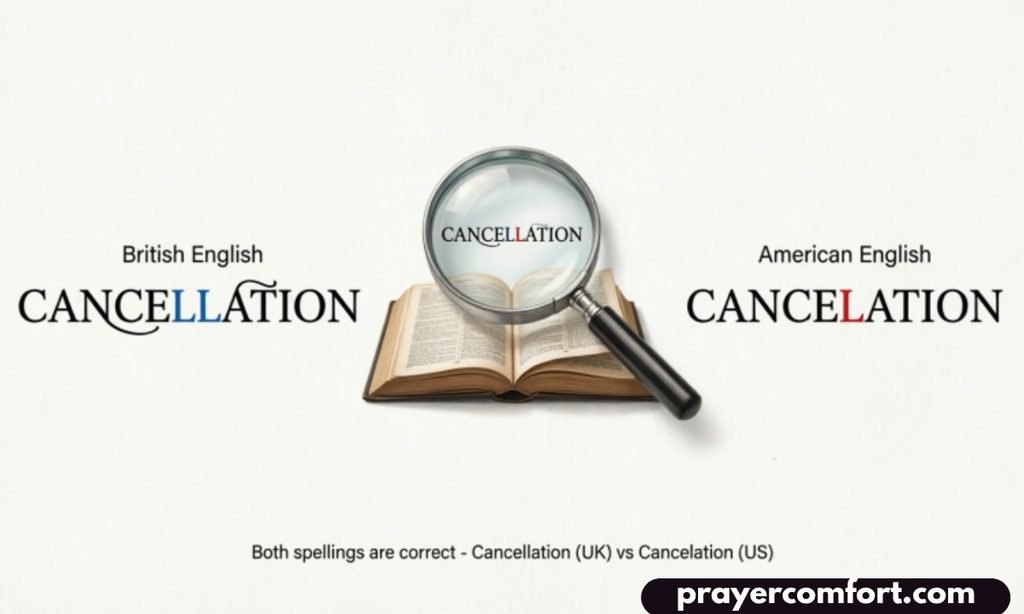
Cancellation is the spelling you should use. It works in formal writing, business emails, news articles, and everyday conversation, no matter which side of the Atlantic your audience is on.
Cancelation isn’t “wrong” in the sense of being banned from dictionaries, but it’s a minor variant that shows up so infrequently that most style guides, editors, and spell-checkers will flag it as nonstandard. If you want your writing to look polished and error-free, stick with the double-L version every time.
Why This Word Confuses So Many Writers
The confusion makes sense once you see where it comes from. Most English writers already know that words like canceled/cancelled and canceling/cancelling split along American and British lines: Americans typically use one L, and British writers double it. So it’s a natural assumption that cancellation would follow the same pattern.
It doesn’t. Cancellation keeps the double L in both American and British English. The single-L “cancelation” never became the standard in the United States, even though the American pattern usually favors simpler spelling. That mismatch is the real source of the confusion.
Cancellation vs Cancelation: The Key Difference
Both words share the same meaning: the act of calling off or stopping something that was planned. The difference is purely spelling, not meaning or usage.
| Term | Correct? | Meaning | Typical Use | Example |
| Cancellation | Yes (standard) | The act of calling something off | All writing, US and UK | “The airline announced the flight cancellation an hour before departure.” |
| Cancelation | Technically accepted, rarely used | Same meaning, minor spelling variant | Almost never recommended | “The event faced a last-minute cancelation.” (uncommon, avoid in formal writing) |
If you remember nothing else from this article, remember this: when in doubt, add the second L.
Where the Double L Comes From
This isn’t an arbitrary rule. It traces back to how English handles suffixes on words ending in a single vowel plus a consonant, like cancel. British English almost always doubles the final consonant before adding endings such as -ing, -ed, or -ation, producing cancelling, cancelled, and cancellation.
American English usually breaks from that pattern and keeps a single L, which is why Americans write canceling and canceled. But cancellation is the exception. Over time, the double-L noun form became so widely used that American English adopted it as standard too, instead of following the “American” single-L pattern you’d expect.
Cancellation vs Canceled/Cancelling: Don’t Mix Them Up
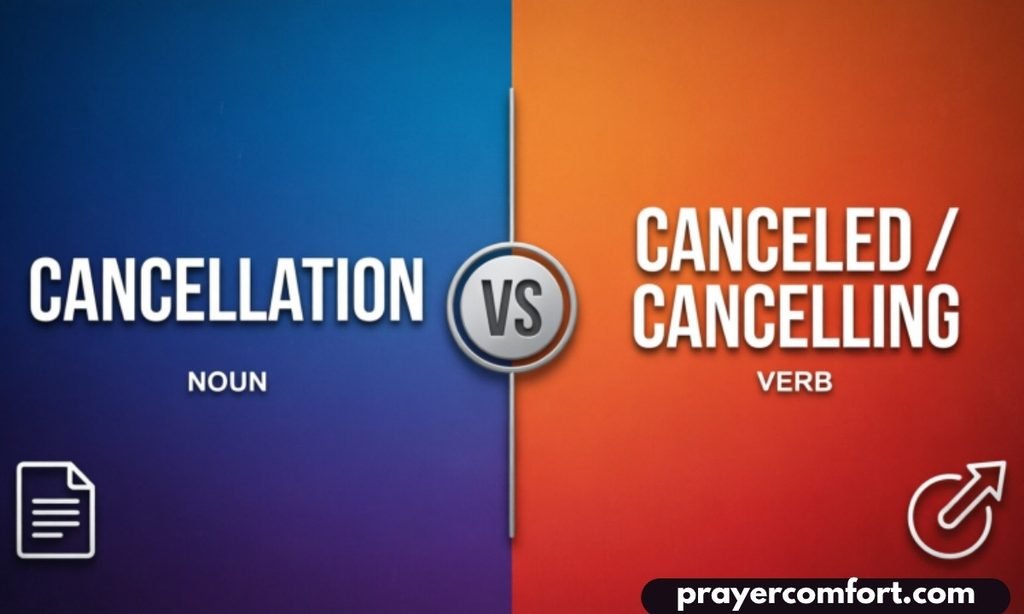
It helps to separate this word from its close relatives, since they don’t all follow the same rule.
- Canceled (US) / Cancelled (UK) past tense of the verb cancel. This one is split by region.
- Canceling (US) / Cancelling (UK) present participle. This one also splits by region.
- Cancellation of the noun form. This one does not split by region; it’s always spelled with two L’s.
So you might correctly write “I canceled my subscription” in American English, but the noun that describes that action is still “the cancellation of my subscription,” not “the cancelation.”
Real-Life Examples
Correct: “We’re sorry for the inconvenience caused by the flight cancellation.”
Incorrect: “We’re sorry for the inconvenience caused by the flight cancellation.” (Not technically forbidden, but it reads as a spelling error to most audiences and isn’t the preferred form.)
Correct (workplace email): “Please confirm the cancellation of tomorrow’s 2 p.m. meeting.”
Correct (text message, informal): “Ugh, cancellation fees are the worst.”
Correct (academic writing): “The study examined how subscription cancellation rates changed after the price increase.”
Correct (social media): “Just got a cancellation confirmation for my gym membership finally!”
Notice that the spelling doesn’t change based on tone or context. Formal, casual, spoken, written cancellation stays the same.
The Mistake People Actually Make
The real-world mistake isn’t usually writing “cancelation” on purpose. It’s typing quickly, trusting muscle memory from canceled and canceling, and dropping the second L out of habit. Autocorrect on some devices won’t always catch it, since “cancelation” is a recognized (if rare) word rather than a nonsense string of letters.
A simple way to remember the fix: think of the word cancellation as having “double trouble” two L’s, just like the double effort it takes to actually cancel something official, like a flight or a contract. If that mental trick doesn’t stick, just default to the version with two L’s whenever you’re unsure. It’s correct far more often than not.
Practical Guidance for Everyday Writing
- Default to cancellation. In emails, reports, articles, and any professional document, this is the safe, expected spelling.
- Don’t worry about US vs UK for this particular word. Unlike canceled/cancelled, region doesn’t change the noun form.
- Let spell-check guide you, but don’t rely on it completely. Some spell-checkers accept “cancelation” without flagging it, so a quick manual check helps.
- Apply the same logic to related nouns. Words like cancellable also tend to keep the double L in standard usage, following the same pattern.
Related Terms Worth Knowing
- Cancellation policy the rules a business sets for canceling a service, booking, or order.
- Cancellation fee is a charge applied when something is canceled after a deadline.
- Cancellation notice is a formal written statement that something has been called off.
All of these compound terms follow the same standard spelling: double L, no exceptions.
Frequently Asked Questions
Is “cancelation” grammatically correct?
It’s not a grammatical error, but it’s a rarely used spelling variant. Some dictionaries list it as an accepted alternative, yet almost no professional style guide recommends it. For clear, polished writing, use “cancellation” instead.
What is the difference between cancellation and cancelation?
There’s no difference in meaning. Both describe the act of calling something off. The only difference is spelling, and “cancellation” is the version used in nearly all modern writing, both American and British.
Why doesn’t cancellation follow the same rule as canceled vs cancelled?
Related verb forms like canceled/cancelled do split by region, with American English favoring one L. The noun cancellation, however, kept its double L in American English over time, making it an exception rather than the rule.
Which spelling should I use for business or academic writing?
Always use “cancellation.” It’s the expected, professional standard across US and UK English, and using the single-L version risks looking like a typo to readers and editors alike.
The Bottom Line
When you’re deciding between cancellation and cancelation, the choice is simple: go with cancellation. It’s the correct, standard, and widely recognized spelling in every English-speaking region, in every context, formal or casual.
The single-L version exists, but it’s uncommon enough that using it can make careful readers pause. Stick with the double L, and you’ll never have to second-guess this word again.


2 thoughts on “Cancellation vs Cancelation: The Truth Revealed 2k26”