

If you’ve ever paused mid-sentence wondering whether to write “the 22th of June” or “the 22nd of June,” you’re not alone. The confusion usually comes from mixing up regular counting numbers with ordinal numbers, which follow their own spelling pattern.
The short answer: 22nd is correct, and “22th” is a common misspelling that doesn’t exist in standard English.
22th or 22nd – Quick Answer

22nd is the only correct way to write this ordinal number. “22th” is never correct in American or British English, no matter the context dates, birthdays, anniversaries, or rankings.
Simple Rule
Ordinal numbers ending in 1, 2, or 3 (except 11, 12, and 13) borrow their suffix from the base number: first, second, and third become -st, -nd, and -rd. Since 22 ends in 2, and “two” becomes “second,” the number takes -nd, giving you 22nd.
The Origin of 22th or 22nd
English ordinal numbers developed from the words first, second, and third, long before numerals were commonly used in writing. When numbers began appearing in shortened form (like “1st” or “2nd”), writers kept the final letters of the spelled-out word attached to the digit.
That’s why 22nd keeps the “nd” from “second” instead of taking a generic “th.” The mistake “22th” likely comes from readers applying the more common -th pattern (used for 4th, 5th, 6th, and so on) to every number without checking the exception.
Don’t Miss : Knaw or Gnaw
British English vs American English Spelling
Here’s some good news: this isn’t one of those cases where American and British English disagree. Both varieties use 22nd consistently, whether in formal writing, journalism, or casual conversation.
Comparison Table
| Region | Correct Form | Notes |
| American English | 22nd | Used in dates, addresses, and rankings |
| British English | 22nd | Identical spelling; date order may differ (22nd June vs June 22nd) |
The only real difference between the two dialects is date order, not spelling. British writers often place the ordinal before the month (“22nd June”), while American writers typically place it after (“June 22nd”).
22th or 22nd meaning
22nd is the ordinal form of the number 22. It shows position or order in a sequence rather than quantity. While “22” tells you how many of something there are, “22nd” tells you where something falls in a list, calendar, or ranking such as the 22nd day of the month or the 22nd person in line.
Which Spelling Should You Use?
Always use 22nd. There is no formal, informal, regional, or historical context where “22th” is acceptable. This isn’t a stylistic choice like “gray” versus “grey” it’s a straightforward spelling rule with one correct outcome.
Audience-Based Usage
- Students and academic writers: Use 22nd in essays, citations, and formal papers.
- Business professionals: Use 22nd in emails, contracts, and scheduling documents.
- Casual writers and texters: Even in informal messages, 22nd is expected; “22th” reads as a typo, not a stylistic shortcut.
Common Mistakes with 22th or 22nd
The mistake almost always comes down to one thing: applying the wrong ordinal suffix.
Common Errors and Fixes
| Error | Fix |
| Writing “22th” | Replace with 22nd |
| Assuming all numbers use “-th” | Remember the 1, 2, 3 exception rule |
| Mixing suffixes in a list (“21st, 22th, 23th”) | Check each number individually |
Incorrect Example
“We’ll meet on the 22th of March.”
Correct Example
“We’ll meet on the 22nd of March.”
Why the Mistake Happens
Most ordinal numbers do end in -th (4th, 5th, 9th, 10th, 20th), so writers often assume every number follows that pattern. The exception applies only to numbers ending in 1, 2, or 3 and only when they aren’t 11, 12, or 13. Since 22 ends in 2, it breaks from the “-th” pattern and takes “-nd” instead.
Read Also : TS Meaning in Text
Easy Rule for Ordinal Numbers
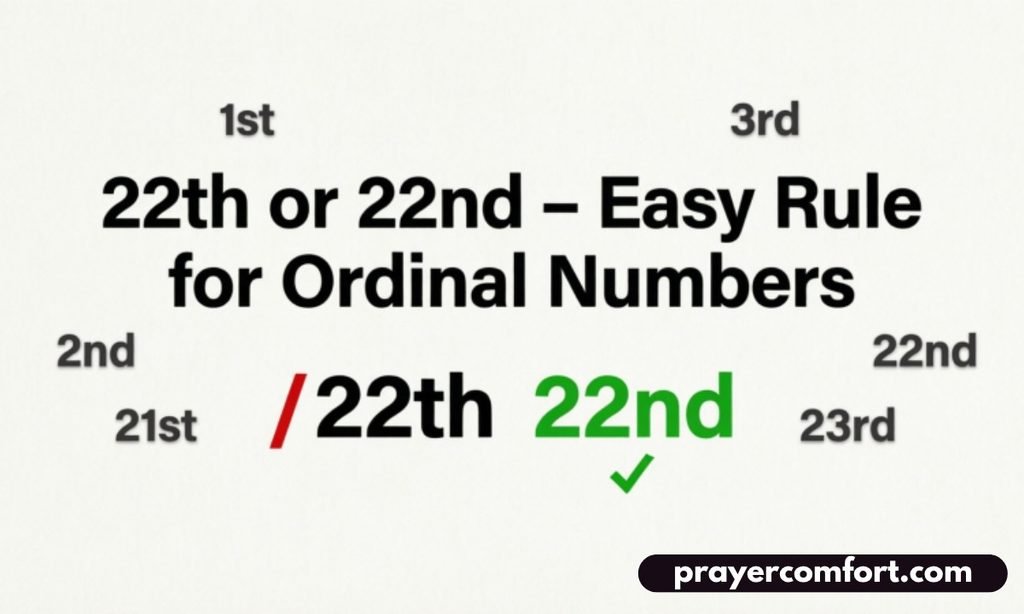
Look at the last digit of the number, not the whole number:
- Ends in 1 → -st (21st, 31st) except 11
- Ends in 2 → -nd (22nd, 32nd) except 12
- Ends in 3 → -rd (23rd, 33rd) except 13
- All other endings → -th (24th, 25th, 100th)
Exceptions
Numbers ending in 11, 12, or 13 always take -th, regardless of the final digit. That’s why it’s “11th,” “12th,” and “13th,” not “11st,” “12nd,” or “13rd.”
22th or 22nd in Everyday Examples
Seeing the correct form in real contexts makes the rule easier to remember.
Emails
“Please submit your report by the 22nd.”
News
“The event drew record crowds on its 22nd anniversary.”
Social Media
“Can’t believe I’m turning 22 on the 22nd! 🎉”
Formal Writing
“The company was founded on the 22nd of October, 1998.”
Invitations
“You’re invited to celebrate on Saturday, the 22nd of August.”
22th or 22nd birthday

When wishing someone well, the correct phrase is “Happy 22nd birthday,” not “Happy 22th birthday.” The same ordinal rule applies here as anywhere else the number 22 always takes the “-nd” suffix.
22th or 22nd September
Whether written in British or American style, the correct form is 22nd September or September 22nd. The date order changes by region, but the ordinal spelling never does.
22th or 22nd july
The same rule holds for any month. It’s always 22nd July or July 22nd never “22th July” in any standard English usage.
22th or 22nd – Google Trends & Usage Data
Why People Search This Keyword
Most people search this phrase while writing dates, invitations, or birthday messages and pause because “22th” looks like it should follow the common “-th” pattern used elsewhere.
Popular Countries
This confusion tends to show up most often among English learners and native speakers alike, since the ordinal exception isn’t always taught explicitly in school.
Usage Contexts
The mix-up appears most frequently in scheduling emails, birthday greetings, calendar invites, and casual text messages where writers type quickly without double-checking the ordinal ending.
Comparison Table: 22th vs 22nd
| Term | Correct? | Meaning | Typical Use | Example |
| 22th | No | N/A not a valid English word | N/A | ❌ “the 22th of May” |
| 22nd | Yes | Ordinal form of 22 | Dates, rankings, birthdays | ✅ “the 22nd of May” |
Ordinal Numbers Similar to 22nd
The same “-nd” pattern applies to other numbers ending in 2:
- 2nd (second)
- 32nd (thirty-second)
- 42nd (forty-second)
- 52nd (fifty-second)
- 62nd (sixty-second)
Memory Trick to Remember 22nd
Think of it this way: 22 sounds like “twenty-second,” and “second” already ends in the letters that spell out the ordinal suffix -nd. If you can say the number out loud and hear “second” at the end, you know it takes “-nd,” not “-th.”
Frequently Asked Questions
Can we write 22th?
No. “22th” is not a recognized spelling in English. The correct ordinal form is always 22nd, whether you’re writing a date, a birthday message, or a ranking.
Is it 22nd or 23rd?
This depends on what number you mean. If you’re referring to the number twenty-two in ordinal form, use 22nd. If you mean twenty-three, use 23rd. They represent different numbers, not alternate spellings of the same one.
Is happy 22nd birthday correct?
Yes. “Happy 22nd birthday” is the grammatically correct way to write this greeting. “Happy 22th birthday” is incorrect and should be avoided in cards, messages, or posts.
Is 22nd or 22th correct?
22nd is correct. “22th” is a spelling error that doesn’t appear in any dictionary or style guide, regardless of region or formality level.
Which is correct, 23th or 23rd?
23rd is correct. Like 22nd, it follows the exception rule for numbers ending in 1, 2, or 3, taking “-rd” from the word “third” instead of the generic “-th.”
Conclusion
The rule behind 22nd comes down to one simple pattern: numbers ending in 2 borrow their suffix from “second,” giving you “-nd” instead of “-th.”
Once you remember that 11, 12, and 13 are the only exceptions to the 1-2-3 pattern, you’ll never second-guess a date, birthday message, or ranking again. Stick with 22nd, and you’ll always be grammatically accurate.


1 thought on “22th or 22nd? The Correct Answer Revealed 2026”