

You typed the word, looked at it for a second too long, and now you’re not sure if it’s “tomorrow” or “tommorow.” That hesitation is completely normal this is one of the most commonly misspelled words in English. The short answer: tomorrow is correct. It has one M and two R’s (t-o-m-o-r-r-o-w). Tommorow, with a doubled M, is always a misspelling, no matter how it’s used or where it appears.
Once you see why the mistake happens, it’s easy to stop making it.
How Do You Spell Tomorrow?
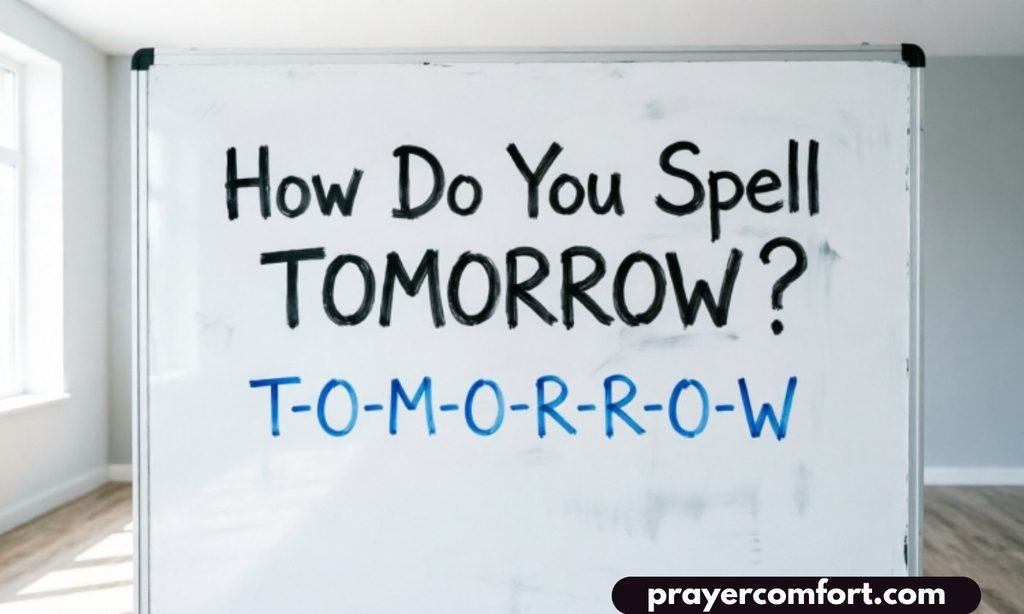
The correct spelling is T-O-M-O-R-R-O-W. It breaks down cleanly into two parts:
- to (one letter T, one letter O)
- morrow (M, then two R’s, then O-W)
Put together, that’s one M total and two R’s total. There’s no version of standard English — American or British — where a second M is correct.
How Many M’s Are in Tomorrow?
One. This is the exact detail that trips people up, because “tommorow” swaps the doubled letter to the wrong spot. Tomorrow has a single M, positioned right after the “to.”
How Many R’s Are in Tomorrow?
Two. The double letter in this word belongs to the R, not the M. Those two R’s sit in the middle, between “mo” and “ow” — mor-row.
How Many Letters Are in Tomorrow?
Tomorrow has 8 letters: T-O-M-O-R-R-O-W. If you ever count 9 letters while writing it out, you’ve likely added an extra M and written “tommorow” by mistake.
Read Also : WYO Meaning in Text
Why Is “Tommorow” Incorrect?
“Tommorow” doubles the wrong consonant. English spelling isn’t always logical, but in this case there’s a clear historical reason for where the double letter goes: tomorrow comes from “to” + “morrow,” an Old English and Middle English word meaning “morning” or “the next day.” Because “morrow” already carries a double R, that doubling carried over when the two words merged into one. The M was never doubled in the original word, so there’s no reason for it to double in “tomorrow” either.
Is “Tommorow” Ever Correct? No. Not in formal writing, casual texting, British English, or American English. There’s no context, dialect, or exception where “tommorow” is the accepted spelling. It’s treated the same way as any other typo — worth fixing, not worth debating.
Why Do People Spell Tomorrow as “Tommorow”?
The mistake is almost always about sound, not carelessness. When you say “tomorrow” out loud, the stress falls on the middle syllable: tuh-MOR-oh. That strong “mor” sound makes the brain assume the letter right before it — the M — must be doubled too, since doubling often signals stress in English (compare “running,” “getting,” “swimming”). The ear hears emphasis and assumes it belongs to the M, when it actually belongs to the R.
A few other things add to the confusion:
- Fast typing. Your fingers move quicker than your spelling instincts, and “tommorow” is an easy slip to make without noticing.
- Autocorrect gaps. Some keyboards and apps still don’t flag it, especially in casual messaging.
- Visual memory of similar words. Words like “tomato” or “tommy” (as a name) use a double M, and that pattern can bleed into “tomorrow” by association.
Understanding why the error happens is often what finally makes it stick.
Common Misspellings of Tomorrow
“Tommorow” isn’t the only variant people type by accident. Here’s how the most frequent ones compare:
| Misspelling | What’s Wrong | Correct Version |
| Tommorow | Doubles the M instead of the R | Tomorrow |
| Tommorrow | Doubles both the M and the R | Tomorrow |
| Tomorow | Only uses one R instead of two | Tomorrow |
| Tommarow | Doubles the M and swaps the second O for an A | Tomorrow |
| Tomarrow | Swaps the second O for an A, keeping only one M | Tomorrow |
In a sentence:
Incorrect: I’ll call you tommorow morning. Correct: I’ll call you tomorrow morning.
Incorrect: The deadline got moved to tomarrow. Correct: The deadline got moved to tomorrow.
In every case, the fix is the same: one M, two R’s, second vowel is an O.
Is Tomorrow Double R?
Yes — tomorrow always has a double R, and that’s the detail worth memorizing above all others. If you remember nothing else from this article, remember this: the R doubles, the M doesn’t.
Why Is the R Doubled in Tomorrow?
The double R comes straight from “morrow,” the older English word for “morning” or “the next day” that tomorrow was built from. “Morrow” itself has always carried two R’s, going back through Middle English “morwe” to Old English “morgen.” When “to” and “morrow” fused into a single word, the spelling of “morrow” — double R included — stayed intact.
Easy Way to Remember the Double R
A few memory tricks make this permanent:
- Think “to + morrow.” Split the word in your head every time you write it. “Morrow” clearly has two R’s, and that’s the half that keeps them.
- Use the phrase “one M today, two R’s toMoRRow.” The capital letters spell out the pattern directly.
- Compare it to “borrow.” Both words share the “-orrow” ending with a double R, so if you can spell “borrow” correctly, you already know how the ending of “tomorrow” should look.
- Say it in syllables while spelling. To-mor-row. Say each syllable as you type each part, and the double R becomes automatic.
Tomorrow vs Yesterday
“Tomorrow” and “yesterday” are opposites in meaning, but they’re built differently. Yesterday refers to the day before today, while tomorrow refers to the day after today. Neither word has an unusual double-letter trap the way tomorrow does — “yesterday” is spelled exactly as it sounds, which is part of why “tomorrow” catches people off guard by comparison.
| Word | Meaning | Common Spelling Mistake |
| Tomorrow | The day after today | Tommorow (extra M) |
| Yesterday | The day before today | Rarely misspelled |
Both words function as adverbs and nouns: “See you tomorrow” (adverb) and “Tomorrow is a new day” (noun); “I called yesterday” (adverb) and “Yesterday was hectic” (noun).
“Tomorrow’s” vs “Tomorrows”: Which Is Correct?
This is a separate question from spelling, and it depends entirely on what you’re trying to say.
- Tomorrow’s (with an apostrophe before the S) is possessive. Use it when something belongs to tomorrow: tomorrow’s weather, tomorrow’s meeting, tomorrow’s plans.
- Tomorrows (no apostrophe) is the rare plural form, used when talking about multiple future days in a poetic or abstract sense: “She lived for her tomorrows, not her yesterdays.”
- Tomorrows’ (apostrophe after the S) would only apply if you were describing something belonging to multiple tomorrows — an extremely uncommon construction that rarely shows up outside of very deliberate writing.
Quick test: if you can rephrase the sentence as “the ___ of tomorrow,” you need the possessive tomorrow’s. “Tomorrow’s forecast” = “the forecast of tomorrow.”
Correct: Tomorrow’s meeting has been moved to 3 p.m. Incorrect: Tomorrows meeting has been moved to 3 p.m.
“To Morrow” and “To-Morrow”: Older Forms You May Still See
If you’ve read older books, letters, or Shakespeare, you may have noticed “to-morrow” written with a hyphen, or even “to morrow” as two separate words. These aren’t modern misspellings — they’re historical spellings that reflect an earlier stage of the English language, before “to” and “morrow” had fully merged into one word.
- “To morrow” (two words) was common in Old and early Middle English, when the phrase literally meant “on the following morning.”
- “To-morrow” (hyphenated) was standard in much English writing through the 18th and 19th centuries, including in classic literature.
- “Tomorrow” (one word, no hyphen) became the standard modern spelling by the 20th century and is the only form used in contemporary American and British English today.
You should not use “to morrow” or “to-morrow” in modern writing, whether formal or casual — they’ll read as either a typo or an odd stylistic choice rather than a nod to history. Save them for direct quotations of older texts.
Why Tomorrow Is Hard to Spell (and How to Fix It for Good)
Tomorrow lands on lists of commonly misspelled English words for a simple reason: its pronunciation doesn’t clearly signal its spelling. The stressed syllable makes the M sound like it should double, when it’s actually the unstressed R sound that carries the double letter. This mismatch between how a word sounds and how it’s spelled is common in English — think “necessary,” “definitely,” or “occurrence” — and tomorrow is one of the most frequent examples people run into daily, simply because they type or say the word so often.
The fix isn’t complicated. Most people stop misspelling tomorrow once they:
- Learn the “to + morrow” breakdown
- Practice the double-R memory phrase a few times
- Notice the pattern in similar words like “borrow” and “sorrow”
After that, the correct spelling becomes automatic rather than something you have to double-check.
Other Words With the Same Double-Letter Trap
Tomorrow isn’t alone. A handful of English words cause the same kind of confusion because the doubled letter isn’t where the stress seems to suggest:
- Occurred / occurring — double R, not double C at the point people expect
- Embarrass — double R and double S, frequently under-doubled
- Recommend — one C, two M’s (often reversed by writers)
- Necessary — one C, two S’s (commonly written the other way around)
If tomorrow has ever tripped you up, these are worth a quick mental note too.
Tomorrow as an Adverb and a Noun
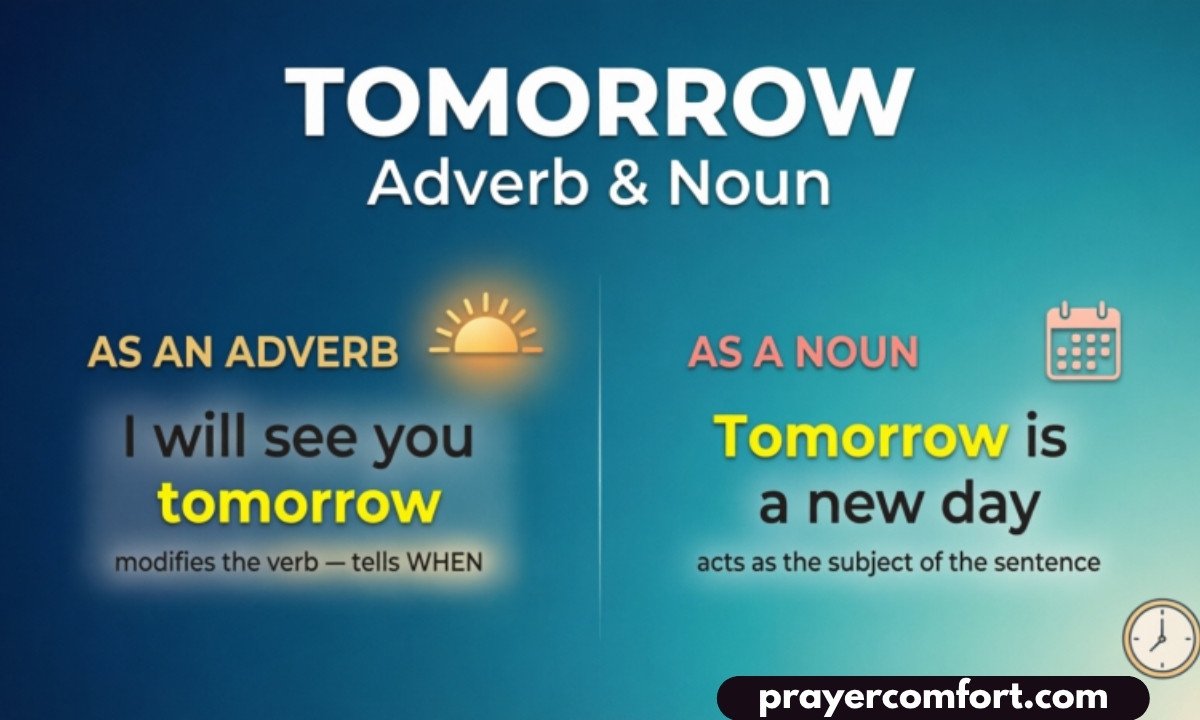
Tomorrow is one of the more flexible time words in English because it works as both an adverb and a noun, without changing its spelling.
As an adverb, it modifies a verb and tells you when something happens:
- We’re leaving tomorrow.
- Can you call me tomorrow morning?
As a noun, it refers to the day itself as a concept or subject:
- Tomorrow is going to be busy.
- Nobody knows what tomorrow holds.
You don’t need to worry about choosing the “right form” — tomorrow doesn’t change spelling between these uses the way some words do. Context alone tells you which role it’s playing in the sentence.
When to Use a Specific Date Instead of “Tomorrow”
In everyday conversation, “tomorrow” is clear enough. But in written communication — emails, contracts, calendar invites, official notices — it can create confusion if the reader opens the message on a different day than it was written. A better practice in formal or time-sensitive writing is to pair “tomorrow” with the actual date, or replace it entirely:
- The report is due tomorrow (Tuesday, September 1).
- The report is due September 1.
This avoids the classic problem of someone reading “I’ll send it tomorrow” three days after it was sent.
Correct Examples in Everyday Writing
Seeing tomorrow used correctly across different contexts helps the spelling stick.
Text message: Running late, see you tomorrow instead 🙌
Workplace email: I’ll have the revised draft to you by tomorrow afternoon.
Academic writing: The experiment will be repeated tomorrow to confirm the results.
Social media caption: Big day tomorrow — wish us luck!
Formal writing: The committee will reconvene tomorrow at 10:00 a.m. to finalize the proposal.
Incorrect vs. Correct Sentence Fixes
| Incorrect | Correct |
| I’ll finish it tommorow. | I’ll finish it tomorrow. |
| See you tommorow! | See you tomorrow! |
| The exam is tomarrow. | The exam is tomorrow. |
| Tommorows forecast looks rainy. | Tomorrow’s forecast looks rainy. |
Common Phrases With Tomorrow
Tomorrow shows up in several set expressions that are worth knowing, since they’re often searched for on their own:
- “Tomorrow is another day” — a saying used to express optimism after a bad day.
- “There’s no tomorrow” — used to describe acting without regard for future consequences, as in “spend money like there’s no tomorrow.”
- “Tomorrow never comes” — a phrase warning against constantly postponing something.
“Tomorrow, and Tomorrow, and Tomorrow”
This phrase comes from Macbeth’s famous soliloquy in Shakespeare’s Macbeth, where the repetition of “tomorrow” is used to express the monotonous, uncertain passage of time. It’s frequently quoted or referenced in literature, film, and even book titles, which is part of why people search for it — but note that it’s a literary reference, not a grammar rule, and the spelling of “tomorrow” within it follows the same modern rules covered above.
Synonyms and Alternatives for Tomorrow
Depending on tone and context, a few alternatives can stand in for “tomorrow”:
- The next day — neutral, works in narrative or formal writing
- The following day — slightly more formal, common in reports and news writing
- The day after today — literal and clear, though rarely used outside of definitions
What comes after tomorrow? The day after tomorrow doesn’t have its own single-word name in English the way “tomorrow” and “yesterday” do — it’s simply referred to as “the day after tomorrow.” Some languages have a dedicated word for this concept, but English does not.
Frequently Asked Questions
Is “tommorow” ever grammatically acceptable?
No. “Tommorow” is a spelling error, not a grammar variant, dialect form, or acceptable shorthand. It should be corrected to “tomorrow” in every context, from texting to academic writing.
What is the old-fashioned way to say “tomorrow”?
Older English used “morrow” on its own, or the two-word phrase “to morrow,” to mean the next day. You may still see “to-morrow” with a hyphen in classic literature, but modern English uses the single word “tomorrow.”
How can I remember how to spell tomorrow permanently?
Break it into “to” + “morrow,” and remember that the double letter belongs to the R in “morrow,” not the M. Comparing it to “borrow,” which shares the same “-orrow” ending, is one of the fastest ways to make the pattern stick.
Is there a difference between “tomorrow” in American and British English?
No. “Tomorrow” is spelled identically in American and British English, with no regional variation. This is one of the rare time-related words where both dialects agree completely.
Conclusion
Tomorrow is spelled with one M and two R’s — t-o-m-o-r-r-o-w — and “tommorow” is always incorrect, regardless of context, tone, or dialect. The mix-up happens because the word’s pronunciation makes the M sound like it should double, when the doubling actually belongs to the R from its root word, “morrow.”
Once you connect the spelling to “to + morrow” and compare it to a word like “borrow,” the correct form becomes easy to remember — and one less thing to second-guess the next time you’re writing about what’s coming tomorrow.


1 thought on “Tomorrow vs Tommorow: Discover the Correct Spelling”