
You spot a fuzzy green patch in the fridge and pause before typing your question into Google. Is it mold or mould? You have seen both spellings online, in books, and even on cleaning product labels, and now you are not sure which one is actually correct.
Here is the short answer: mold is the American spelling, and mould is the British spelling. Both words mean the exact same thing. There is no secret difference in meaning, only a difference in geography. Once you know that, everything else about this word gets a lot easier.
Is It Mold vs Mould?
Yes, this is a real spelling split, not a typo you have been missing your whole life. Mold is used in the United States and Canada tends to lean American in casual writing. Mould is used in the United Kingdom, Australia, and most Commonwealth countries.
Think of it like color and colour, or favorite and favourite. Same word, same meaning, different side of the ocean. The letter “u” is the only thing standing between them.
What Does Mold Mean?
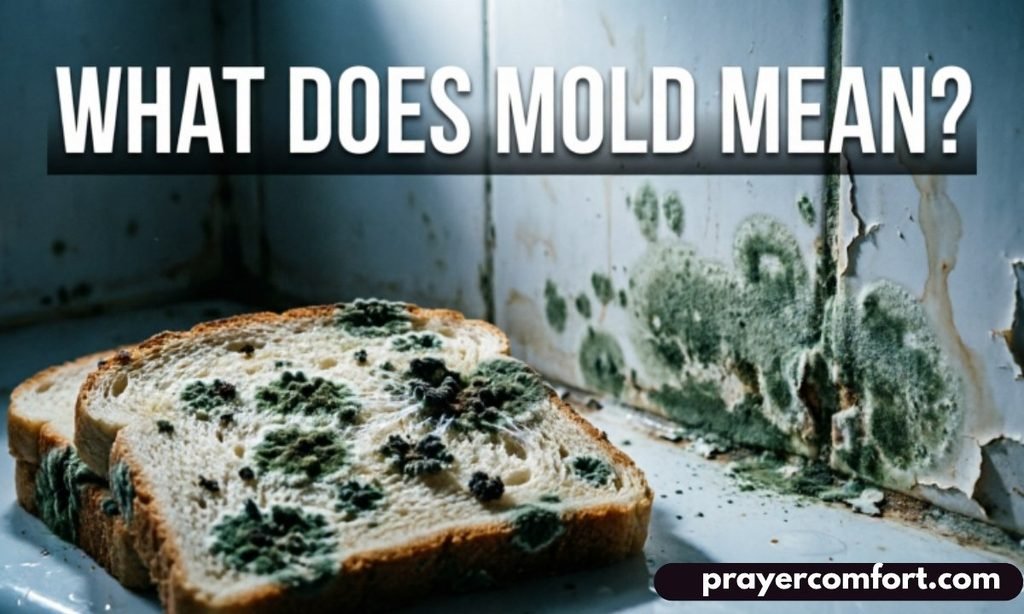
The word mold carries three main jobs in American English, and mixing them up is where most confusion starts.
Mold as a Fungus
This is the meaning most people search for first. Mold is a fuzzy, often green, black, or white fungus that grows on damp food, walls, or fabric. It thrives in moisture and spreads through tiny spores floating in the air.
Mold as a Shape or Form
Mold also means a hollow container used to shape a soft material into a solid form. Think of a cake mold, a jelly mold, or an ice cube mold. You pour liquid in, it sets, and it comes out shaped exactly like the container.
Mold as a Verb
Mold can also be a verb meaning to shape or influence something. A sculptor molds clay. A good teacher molds young minds. Neither of these examples involves fungus at all, which is exactly why context matters so much with this word.
What Does Mould Mean?
Mould does the same three jobs mold does, just with British spelling rules attached.
Mould as Fungus
In British English, that fuzzy growth on old bread is called mould, not mold. Same fungus, same smell, same reason to throw the bread away immediately.
Mould as a Container
A British baker uses a mould to shape a jelly or a cake, the same way an American baker uses a mold. The tool and the technique are identical.
Mould as a Verb
To mould someone’s character or mould a piece of metal into shape works the same way as the American verb form. The action does not change, only the spelling does.
Molding or Moulding
This one trips people up constantly. Molding (American) and moulding (British) refer to decorative strips of wood or plaster used along walls, ceilings, and doorframes. It has nothing to do with fungus, even though the spelling looks almost identical.
If you are reading a home renovation blog and see “crown moulding,” that is a British or Commonwealth spelling of a construction term, not a warning about fungus in your ceiling.
Read More Articles
👉 Bougie vs Boujee: The Shocking Difference Explained
Laid Out or Layed Out? The Correct Answer Revealed
Verbage or Verbiage? Master the Difference Fast
Mold vs Mould What’s the Difference?
The core difference is regional spelling, not meaning. Here is a quick comparison table so you can see it at a glance.
| Feature | Mold (American) | Mould (British) |
| Fungus meaning | Yes | Yes |
| Container meaning | Yes | Yes |
| Verb meaning | Yes | Yes |
| Used in | US, Canada (mixed) | UK, Australia, most Commonwealth countries |
| Pronunciation | Same | Same |
| Grammar rules | Identical | Identical |
Everything lines up except that single letter. Once you accept that, the rest is just about knowing your audience.
Mold vs Mould in American vs British English
Spelling habits are shaped by history, education systems, and even old dictionaries, so let’s break this down by region.
American English
The United States almost always uses mold, thanks in large part to Noah Webster’s spelling reforms in the early 1800s. Webster wanted American English to look simpler and more distinct from British English, and dropping unnecessary letters like the “u” in mould was part of that project.
British English
British English keeps the “u” because it follows older spelling traditions rooted in French influence on the English language. The UK never adopted Webster’s simplified spelling system, so mould stayed the standard.
Canadian English
Canada sits in an interesting middle ground. Many Canadians write mould in formal or government documents, following British tradition, but everyday and American media influence often nudges casual writers toward mold. Both spellings are widely understood there.
Australian English
Australia follows British spelling conventions closely, so mould is the standard choice in newspapers, schools, and official writing across the country.
International Writing Tips
If you are writing for a global audience, pick one spelling and stay consistent throughout the entire piece. Mixing mold and mould in the same document looks like a proofreading mistake, even though both are technically correct somewhere in the world.
Mold vs Mould Meaning in Different Contexts
Context tells you almost everything you need to know about which meaning applies, regardless of which spelling you use.
Mold vs Mould Fungus
Household fungus growth is the most searched meaning by far. It appears on walls, ceilings, food, and fabric, and it is the version people worry about health wise.
Mold vs Mould Spores
Spores are the microscopic reproductive cells that mold and mould release into the air to spread. According to the CDC, mold spores are present almost everywhere indoors and outdoors, and problems usually start when moisture allows them to multiply rapidly in one spot.
Mold vs Mould in Bathroom
Bathrooms are prime real estate for fungus growth because of constant humidity from showers and poor ventilation. Grout lines, shower curtains, and ceiling corners are the usual suspects.
Mold vs Mould on Food
Food fungus spreads fast on soft, moist items like bread, berries, and soft cheese. The USDA recommends throwing out soft foods entirely if fungus appears, since roots can spread deeper than what is visible on the surface.
Mold vs Mould in Manufacturing
In manufacturing, a mold (or mould) is a hollow tool that shapes liquid or semi liquid material into a solid product once it cools or sets. This applies to plastics, metals, rubber, and even chocolate.
Injection molding, for example, is a massive global industry. The plastic injection molding market alone was valued at well over 250 billion dollars in recent industry reports, showing just how central this manufacturing meaning really is.
Mould vs Mold Casting
Casting is closely related but slightly different. Casting is the process, and the mold or mould is the tool used inside that process. You pour molten metal, resin, or another material into the mold, let it cure, and then remove the finished cast piece.
Common Manufacturing Molds
- Injection molds for plastic parts like bottle caps and toys
- Sand molds for metal casting in foundries
- Silicone molds for resin art and jewelry
- Compression molds for rubber products like tires
Mold vs Mould in Baking
Bakers use molds (or moulds) to shape cakes, bread, chocolate, and jelly into specific forms. A bundt pan is technically a mold, even though most people never call it that out loud.
Mold vs Mould in Cooking
Beyond baking, cooking uses molds for gelatin desserts, ice sculptures, butter shapes, and even pasta dies. The tool concept stays the same across every kitchen application.
Mold vs Mould in Construction
Construction workers deal with both meanings constantly. They install molding or moulding as decorative trim, and they also have to inspect buildings for fungus growth caused by water damage, leaky pipes, or poor insulation. Knowing which meaning applies usually comes down to context clues in the sentence.
Mold or Mould on Walls
Wall fungus usually points to a moisture problem hiding behind the surface. Common causes include leaking pipes, poor ventilation, condensation, and roof leaks. If you see dark spots spreading across drywall, that is almost always fungus growth rather than dirt or staining.
Mold or Mould in Medicine
In medical contexts, fungus exposure can trigger allergic reactions, asthma flare ups, and respiratory irritation in sensitive individuals. The World Health Organization has linked damp indoor environments with an increased risk of respiratory symptoms, particularly in children and people with existing lung conditions. Anyone dealing with unexplained breathing issues in a damp home should consider professional testing rather than guessing.
Origin and History of Mold and Mould
The word traces back to Middle English “molde,” which itself came from Old French “modle” and Latin “modulus,” meaning a small measure or standard. Interestingly, the fungus meaning developed separately from an older word related to “moulder,” meaning to decay or crumble away.
Noah Webster’s 1828 American Dictionary of the English Language is the real turning point here. Webster intentionally trimmed silent or unnecessary letters from many words, including dropping the “u” from mould, colour, and honour. British English simply never adopted those reforms, which is why the split still exists today, two centuries later.
Why Spell Checkers Suggest Different Spellings
Your spell checker is not confused, it is just set to a specific regional dictionary. If your software is set to US English, it will flag mould as incorrect and suggest mold. Set it to UK English, and the opposite happens. Always check your language settings before assuming your spelling is wrong.
Common Mistakes People Make
Most mold and mould mistakes come from a handful of predictable habits, and once you spot them, they are easy to fix.
Mixing US and UK Spellings
Writers sometimes switch between mold and mould within the same document without realizing it, usually because they copied text from different sources. Pick one and stick with it from start to finish.
Assuming One Spelling Is Wrong
Neither spelling is objectively wrong. They are regional variants, similar to soccer and football, or truck and lorry. Correctness depends entirely on your intended audience.
Ignoring Your Audience
Writing mold in a British newspaper or mould in an American textbook will look out of place, even though the word itself is spelled correctly for the other region.
Confusing Mold With Molding
People sometimes assume any mention of molding or moulding refers to fungus, when it actually refers to decorative trim in construction and design. Reading the surrounding sentence almost always clears this up instantly.
Similar American and British Spelling Differences
Mold and mould are not alone. English has plenty of similar splits caused by the same historical spelling reforms.
- Color (US) vs Colour (UK)
- Favorite (US) vs Favourite (UK)
- Center (US) vs Centre (UK)
- Realize (US) vs Realise (UK)
- Gray (US) vs Grey (UK)
Mold or Mould Examples
Seeing the word used in real situations makes the choice much clearer than any definition alone.
Home Inspection
“The inspector found mold growing behind the bathroom tiles.” (US) “The inspector found mould growing behind the bathroom tiles.” (UK)
Construction
“Workers installed new crown molding along the ceiling.” (US) “Workers installed new crown moulding along the ceiling.” (UK)
Baking
“She poured the batter into a silicone mold shaped like a rose.” (US) “She poured the batter into a silicone mould shaped like a rose.” (UK)
Gardening
“Damp soil left in the shed too long can develop mold.” (US) “Damp soil left in the shed too long can develop mould.” (UK)
School Writing
American students writing for US teachers should use mold consistently, while students in the UK, Australia, or most Commonwealth schools should use mould.
Business Writing
Companies writing content for a specific regional market should match that region’s spelling convention exactly, since inconsistency can look unprofessional to careful readers.
Mold or Mould in a Sentence
Here are a few more natural examples to anchor the pattern in your memory.
- “Old leftovers in the fridge often grow mold within days.” (US)
- “Old leftovers in the fridge often grow mould within days.” (UK)
- “The factory uses a steel mold to shape car parts.” (US)
- “The factory uses a steel mould to shape car parts.” (UK)
Tips for Choosing the Correct Spelling
Ask yourself who your reader is. If you are writing for a US audience, publication, or client, use mold. If your audience is British, Australian, or from most Commonwealth countries, use mould. When in doubt, check your target website’s existing content and match its established style.
Is Mold or Mould More Common?
Globally, mold sees higher search volume overall, largely because of the size of the American internet audience and search behavior. However, mould remains the standard and expected spelling across a huge portion of English speaking countries outside the US, so popularity does not equal universal correctness.
Practice Session Mold vs Mould
Try filling in the blank with the correct spelling based on the region mentioned in parentheses.
- The bread in the pantry grew ______ over the weekend. (US)
- She used a silicone ______ to make chocolate hearts. (UK)
- Crown ______ adds a finished look to any room. (US)
- Damp basements are a common source of ______ growth. (UK)
- The sculptor let the clay ______ his career for decades. (US, verb form)
Answers
- Mold
- Mould
- Molding
- Mould
- Mold
Frequently Asked Questions
How do you spell mold as in a casting?
Both mold and mould are correct for the casting meaning, depending on your region. American English uses mold, while British English uses mould, and the manufacturing process itself does not change based on spelling.
Is it mold or mould for fungus?
It is mold in American English and mould in British English. Both refer to exactly the same type of fungus growth, so the choice comes down to your intended audience.
Is it mold or mould in the UK?
The UK uses mould for every meaning of the word, including fungus, containers, and the verb form. Mold is considered the American spelling and is rarely used in official UK writing.
What is correct, mold or mould?
Both are correct English spellings. Mold is standard in American English, and mould is standard in British, Australian, and most Commonwealth English. Neither spelling is a mistake, as long as it matches your audience’s expectations.
Final Thoughts
Mold and mould are the same word wearing two different regional outfits. Once you know your audience, the choice becomes automatic rather than confusing. American readers expect mold, British and Commonwealth readers expect mould, and both spellings carry the exact same meanings across fungus, containers, and shaping actions.
The next time that question pops into your head while staring at questionable leftovers, you will already know the answer, and you might even impress someone with the Noah Webster trivia while you are at it.

Ethan is a passionate content creator and SEO specialist with 2 years of hands-on experience in crafting compelling digital narratives.A peaceful space to find daily prayers, uplifting blessings, and spiritual inspiration to brighten your life.

1 thought on “Mold vs Mould: The Surprising Difference Explained”