

If you’ve ever typed “I realy love this” and paused before hitting send, you’re not alone. The word sounds like it only needs one “l,” but English spelling doesn’t always match pronunciation.
Here’s the quick fix: really is the only correct spelling. Realy is a common typo, not an accepted word in any English dictionary, formal or casual.
Realy or Really – Quick Answer
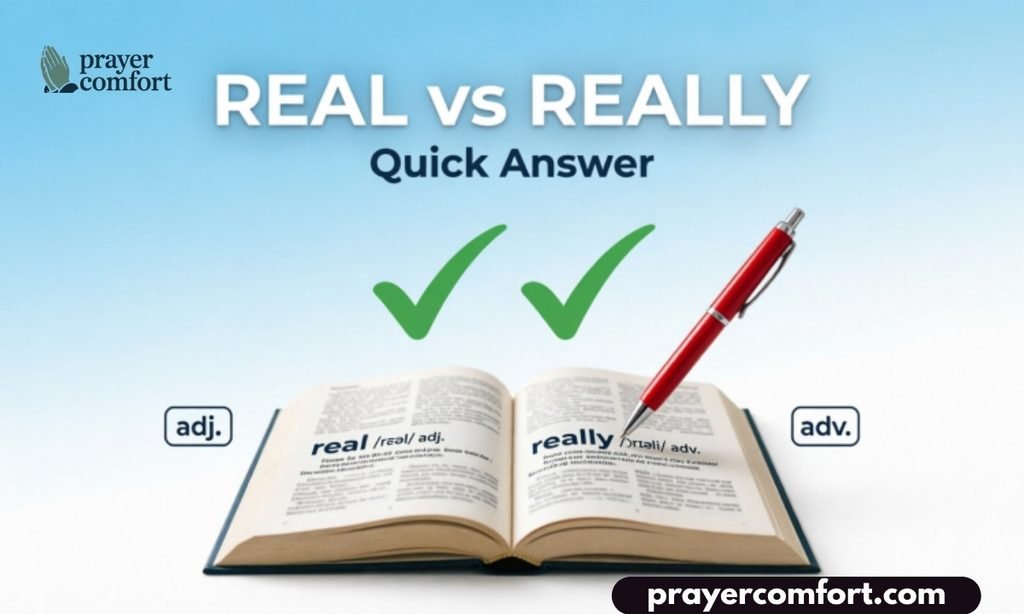
Really is correct. Realy is always a misspelling.
The word is built from the adjective real plus the adverb suffix -ly. Because “real” already ends in “l,” adding “-ly” creates a double “l”: re-a-l-l-y. Dropping one letter to write “realy” breaks that pattern and produces a word that no dictionary, style guide, or spellchecker recognizes as standard English.
What Is “Realy”?
“Realy” has no dictionary entry and no accepted definition. It’s simply a spelling error that happens when a writer drops the second “l” from “really,” usually while typing quickly or relying on how the word sounds rather than how it’s built.
You might see “realy” in text messages, social media comments, or first drafts, but it should never appear in finished writing, whether that’s an email, a school paper, or a business report. If autocorrect doesn’t catch it, a careful proofread will.
What Is “Really”?
Really is an adverb meaning very, truly, genuinely, or in fact. It intensifies an adjective, verb, or entire statement, and it can also express emphasis, surprise, or sincerity depending on where it sits in a sentence.
- “This soup is really good.” (intensifies an adjective)
- “I really need this project to work.” (intensifies a verb)
- “Really, I had no idea.” (expresses sincerity or surprise)
Because it’s so versatile, “really” shows up constantly in both spoken and written English, which is exactly why the misspelling “realy” is so common people hear the word far more often than they see it spelled out.
Realy or Really Adverb

Grammatically, “really” is classified as an adverb, and specifically a degree adverb (also called an intensifier) when it modifies adjectives or other adverbs. It can also function as a sentence adverb, commenting on the truthfulness of an entire statement rather than a single word.
- Degree adverb: “The movie was really long.”
- Sentence adverb: “Really, you shouldn’t have.”
“Realy” has no grammatical classification at all, since it isn’t a recognized word. There’s no version of English formal, informal, spoken, or written where “realy” functions as an adverb or anything else.
How to Pronounce “Realy” vs. How to Pronounce “Really”
Since “realy” isn’t a real word, it has no official pronunciation; people who write it are still saying the word “really” out loud. The spelling confusion comes from speech, not the reverse.
British English Pronunciation of Really
In British English, “really” is typically pronounced /ˈrɪəli/, with a slight diphthong on the first syllable, sometimes softened toward “reer-lee” depending on regional accent.
American English Pronunciation of Really
In American English, “really” is usually pronounced /ˈriːəli/ or a quicker /ˈrɪli/, closer to “REE-lee.” This faster, blended pronunciation is a major reason American writers sometimes drop the second “l” when spelling it.
The Origin of “Really”
“Really” traces back to the adjective real, which entered English through Old French reel, ultimately from the Latin realis, meaning “actual” or “relating to things.” English regularly turns adjectives into adverbs by adding “-ly” (quick → quickly, careful → carefully), and “real” follows the same pattern.
Because “real” already ends in the letter “l,” attaching “-ly” naturally produces a double “l”: real + ly = really. This isn’t an exception to English spelling rules; it’s the rule working exactly as expected, which makes the double “l” easy to justify once you see the word broken into its parts.
Realy Scrabble Word
“Realy” is not a valid word in Scrabble or any official word list used in Scrabble tournaments, including the dictionaries approved for North American and international play. If you’re looking for a high-value word with these letters, “really” itself is playable, but “realy” will be challenged and removed.
British English vs. American English Spelling
Unlike words such as “colour/color” or “travelling/traveling,” “really” does not change between British and American English. Both varieties use the identical spelling double “l,” single word, no regional variant.
This makes “really” easier than many other words: you don’t need to switch spellings based on your audience. Whether you’re writing for a UK publication or a US audience, “really” is always spelled the same way.
Which Spelling Should You Use?
Always use really. There’s no context casual texting, professional email, academic writing, or creative work where “realy” is acceptable. If you want a more formal alternative to “really” in polished writing, consider synonyms like “genuinely” or “significantly” instead of changing the spelling.
Common Mistakes with “Really”

Most errors involving this word come from spelling, not meaning. Here are the patterns to watch for:
Incorrect: “I realy appreciate your help.” Correct: “I really appreciate your help.” Why it’s wrong: the second “l” is missing, breaking the real + ly pattern.
Incorrect: “She was realy tired after the trip.” Correct: “She was really tired after the trip.” Why it’s wrong: same missing-letter error, easy to catch by rereading slowly.
Incorrect: “Realy, I don’t mind at all.” Correct: “Really, I don’t mind at all.” Why it’s wrong: even as a sentence-opening exclamation, the word still needs both “l”s.
A related but separate mistake is confusing “really” with “real” used as an adverb (“that’s real nice”), which is considered nonstandard or dialectal in formal English. Stick with “really” when you need a grammatically standard adverb.
Why Do People Misspell “Really” as “Realy”?
The mistake almost always comes down to speed and sound. In fast speech, the double “l” blends into a single sound, so the ear doesn’t register two separate letters. Add in quick texting, autocorrect gaps, and the general unpredictability of English spelling, and “realy” becomes an easy slip especially for people typing quickly on a phone.
It’s also a visually plausible error. “Realy” looks like it could be correct at a glance, particularly if you’re not thinking about the word’s root (“real” + “-ly”). That’s different from a typo like “erally,” which the eye catches instantly because it doesn’t resemble any recognizable structure.
How to Remember the Correct Spelling of “Really”
A simple trick: mentally split the word into its two building blocks, real and ly. Since “real” already ends in “l,” stacking “ly” on top automatically gives you two “l”s in a row.
Another memory aid is comparing it to similar words built the same way, such as “careful + ly = carefully” or “beautiful + ly = beautifully.” None of those drop a letter when combined, and “really” follows the identical logic; it just looks less obvious because “real” is shorter.
“Realy or Really” Synonyms
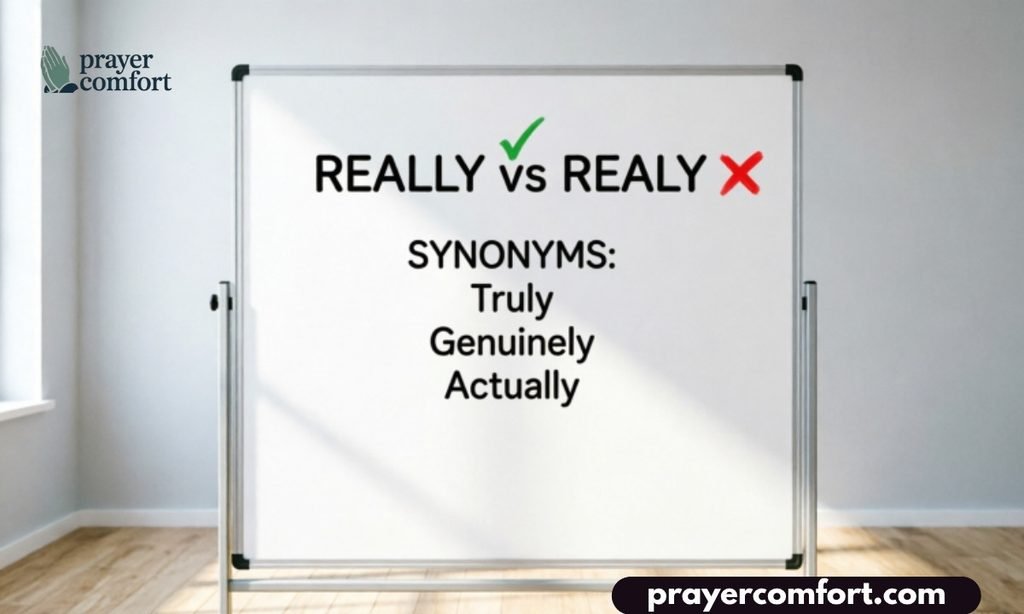
When you want variety instead of repeating “really,” these words work well depending on tone and context:
- Truly – sincere, slightly more formal
- Genuinely – emphasizes honesty or authenticity
- Very – simple, neutral intensifier
- Actually – useful for correcting or clarifying
- Extremely – stronger degree of intensity
- Indeed – formal, often used in writing or speeches
None of these are spelling alternatives to “realy” they’re separate words with their own meanings, useful when you want to avoid overusing “really” in a single piece of writing.
“Really” in Everyday Examples
Emails
“I really appreciate you taking the time to review this proposal before Friday.”
News
“Officials say the new policy will really change how the program is funded going forward.”
Social Media
“This new coffee shop is really underrated, everyone needs to try it.”
Formal Writing
“The data really supports the hypothesis outlined in the second chapter.”
Realy or Really – Google Trends & Usage Data
Search interest for “realy vs really” spikes consistently, reflecting how often typing speed and autocorrect gaps lead people to double-check the spelling. This pattern is typical of high-frequency English words: the more common a word is in speech, the more likely writers are to search for spelling confirmation when typing it quickly.
“Really” remains one of the most frequently used adverbs in both spoken and written American English, which explains why this particular mix-up shows up so often.
Comparison Table: Realy vs. Really
| Term | Correct? | Meaning | Typical Use | Example |
| Really | ✅ Yes | Very, truly, genuinely, in fact | All writing: formal, informal, spoken | “I really enjoyed the concert.” |
| Realy | ❌ No | No accepted meaning; misspelling | Never acceptable | “I realy enjoyed the concert.” (incorrect) |
Frequently Asked Questions
Is it spelled realy or really?
It’s spelled really, with a double “l.” “Realy” is a spelling mistake and doesn’t appear in any standard English dictionary.
What is the meaning of “really”?
“Really” is an adverb meaning very, truly, or genuinely. It can intensify an adjective or verb, or express sincerity and emphasis, as in “Really, I mean it.”
Which is correct: “real” or “really”?
They’re different parts of speech with different jobs. Real is an adjective describing a noun (“a real problem”), while really is an adverb modifying an adjective, verb, or sentence (“a really big problem”). Use “real” before a noun and “really” almost everywhere else.
How do we spell “really”?
Spell it r-e-a-l-l-y: the adjective “real” plus the adverb ending “-ly,” which naturally creates a double “l” since “real” already ends in that letter.


1 thought on “Realy or Really? Powerful Spelling Guide You Need 2026”