
Some prayers never grow old. The Santa María prayer in Spanish is one of them. For hundreds of years, people have turned to this simple but powerful prayer for comfort, hope, and peace. It has been whispered by mothers at bedtime, chanted during Mass, and prayed silently in moments of fear. This prayer connects generations of Spanish-speaking Catholics across the world. Whether you are learning it for the first time or rediscovering it, this article will help you understand its deep meaning, its place in daily life, and why it still matters today.
The Santa María Prayer in Spanish
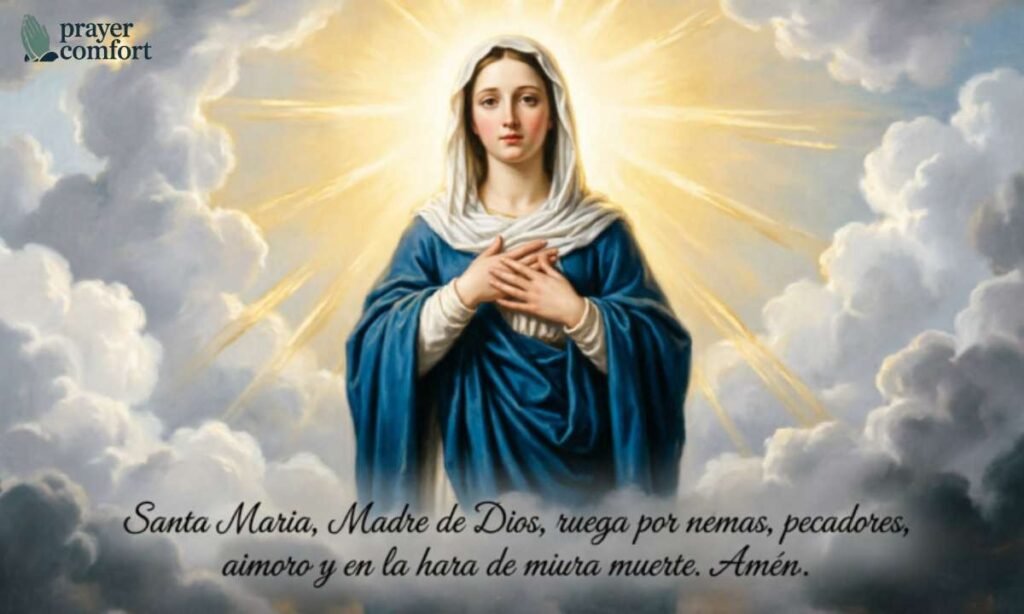
The Santa María prayer, known in Spanish as the Ave María, is one of the most recognized Catholic prayers in the world. Its words are simple. Its message is powerful. The Ave María is rooted in the words of the Angel Gabriel and St. Elizabeth in Scripture specifically Luke 1:28 and Luke 1:42 and it expresses both praise and petition, acknowledging Mary’s role in salvation history and asking for her intercession.
Here is the full text of the prayer in Spanish:
Dios te salve, María, Llena eres de gracia, El Señor está contigo. Bendita tú eres entre todas las mujeres, Y bendito es el fruto de tu vientre, Jesús. Santa María, Madre de Dios, Ruega por nosotros, pecadores, Ahora y en la hora de nuestra muerte. Amén.
And in English:
Hail Mary, full of grace, The Lord is with thee. Blessed art thou among women, And blessed is the fruit of thy womb, Jesus. Holy Mary, Mother of God, Pray for us sinners, Now and at the hour of our death. Amen.
The prayer consists of two parts: the first half recounts the biblical salutations to Mary, while the second half is a heartfelt petition asking for her intercession. This structure beautifully balances scriptural praise with supplication.
The Ave María prayer has its roots in the Latin prayer “Ave Maria,” which originates from the Gospel of Luke. Over centuries, the Church added the petition for Mary’s intercession, creating the full prayer as it is known today. It is a prayer that has stood the test of time. Each word carries weight. Each line carries meaning.
Across cultures, generations, and centuries, few prayers have resonated as deeply within the Christian faith as the Santa María prayer. It is a profound expression of trust in God’s grace and a humble request for the intercession of the Blessed Virgin Mary.
Mary as the Mother of God
One of the most important phrases in this prayer is “Madre de Dios” Mother of God. This title is not just a description. It is a declaration of faith. It tells us who Mary is and what she means to the Christian story.
“Madre de Dios” means “Mother of God.” It affirms the Christian belief that Jesus is fully divine and fully human, emphasizing His incarnation. When we call Mary the Mother of God, we are also saying that Jesus is truly God. These two truths go hand in hand.
The Church formally recognized Mary as Theotokos (God-bearer) at the Council of Ephesus in 431 AD. Since then, this title has been central to Christian devotion. In the Santa María prayer, we acknowledge this truth every time we say her name.
Mary’s role as Mother of God is not about placing her above God. It is about honoring the unique position God gave her. She said yes when the angel asked her to carry the Son of God. That “yes” changed all of human history. The words of the Santa María prayer echo Scripture, tradition, and deep reverence for Mary’s unique role in God’s plan of salvation.
For Spanish-speaking Catholics, the phrase “Madre de Dios” is especially meaningful. It reflects a culture where motherhood is deeply honored. Praying to Mary as the Mother of God feels personal and warm. She is not a distant figure. She is a mother who listens and cares.
When you pray these words, you are connecting with millions of believers who have said them before you. You are standing in a long line of faith.
The Role of Mary’s Intercession
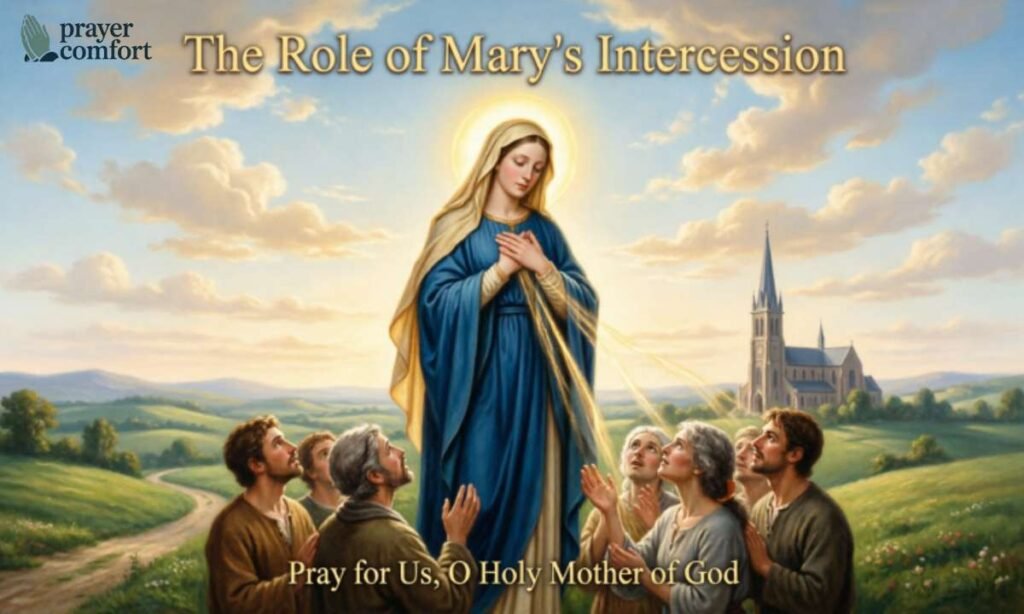
The second half of the Santa María prayer is a request. We ask Mary to pray for us not just now, but at the most important moment of our lives: the hour of our death. This is the heart of Marian intercession.
As Catholics believe, Mary’s intercession is powerful because she is closest to Jesus, her Son. In the Gospel of John, at the Wedding at Cana, we witness the profound influence of Mary’s request when she tells Jesus, “They have no wine,” leading to His first miracle. This demonstrates that Mary is always attentive to our needs and is willing to intercede on our behalf.
So when we ask Mary to “ruega por nosotros, pecadores” pray for us sinners we are not worshipping her. We are asking her to bring our needs to her Son. The Santa María prayer does not replace prayer to God. Instead, it asks Mary to pray for believers, similar to asking fellow Christians to pray for one another, as in James 5:16.
This is an important distinction. Mary is not God. She is a powerful intercessor. She loves like a mother. And like any mother, she wants the best for her children.
Asking Mary to pray for us “now and at the hour of our death” shows real honesty. We know we are sinners. We know life is short. And we trust that Mary will be with us through all of it. Through her, we find a perfect model of faith and discipleship, and praying to Mary is not just a tradition it is an act of faith that brings us into deeper communion with Christ.
The prayer reminds us that we do not face life alone. We have a heavenly mother who intercedes for us every day.
Santa María Madre de Dios Prayer in Spanish
The phrase Santa María, Madre de Dios is the spiritual core of the entire Ave María prayer. These five words carry centuries of theology, devotion, and love. Let us look at what each part means.
Santa María Holy Mary. The word santa means holy or saint. Mary is holy because God chose her. She cooperated with His grace completely. She lived a life fully devoted to God’s will.
Madre de Dios Mother of God. As we explored, this title affirms the Incarnation. Jesus is both God and man. Mary is His mother. Therefore, she is the Mother of God.
In Spanish-speaking countries, this prayer has been a cornerstone of Catholic worship. It is often recited during Mass, the Rosary, and other forms of devotion. Its translation into Spanish allowed more people to connect deeply with the prayer, fostering a sense of unity and faith.
Here is a version of the prayer focused on this central phrase:
Santa María, Madre de Dios, Ruega por nosotros, pecadores, Ahora y en la hora de nuestra muerte. Amén.
These lines are the petition. They are a humble cry for help. We come before Mary not with pride but with honesty. We call ourselves sinners. We ask for her prayer. We trust in her love.
This prayer is used to invite peace into daily life and calm the heart during stress or confusion. Many people return to these words in their hardest moments. When anxiety rises, when grief hits, when fear comes knocking they say Santa María, Madre de Dios, ruega por nosotros.
And in that moment, something shifts. There is a peace that comes from giving your worry to someone who loves you. Mary is that someone.
This part of the prayer is not passive. It is an active faith. You are choosing to trust. You are choosing to ask for help. That takes courage. And Mary honors that courage with her constant intercession.
Click Here To Read Prayer to Break Strongholds
The Santa María Prayer in Daily Devotion
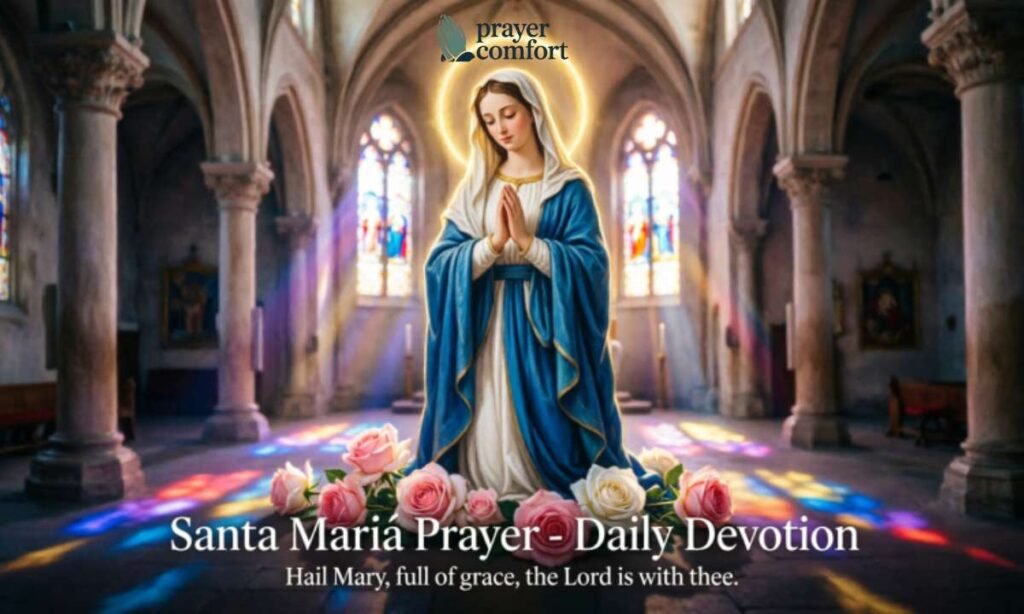
Faith grows when it is practiced every day. The Santa María prayer is perfectly suited for daily devotion. It is short enough to memorize. It is rich enough to reflect on for a lifetime.
Catholics pray the Ave María throughout the day during the Rosary, Angelus, or any time they seek Mary’s intercession and protection. For many families, this prayer is a daily habit. It is said before meals, before sleep, or at the start of a new day.
This prayer is often memorized by children and recited daily by the faithful. Its poetic structure makes it easy to remember and repeat, serving as a comforting routine for many.
There are many ways to include the Santa María prayer in your daily life:
- Morning prayer: Start your day by placing it in God’s hands through Mary’s intercession.
- The Rosary: The Ave María is prayed ten times in each decade of the Rosary. Many Catholics pray the Rosary daily.
- The Angelus: Three times a day morning, noon, and evening Catholics traditionally pause to pray the Angelus, which includes the Ave María.
- Before sleep: End your day with gratitude and trust by offering this prayer before you rest.
- In difficult moments: Whenever you feel anxious, sad, or overwhelmed, let these words bring you back to peace.
The Santa María prayer can be prayed at any time during daily devotion, while praying the Rosary, in moments of anxiety, or before sleep. Many believers pray it morning and night.
The beauty of this prayer is that it works at any pace. You can rush through it in seconds. Or you can sit with each line for minutes. Both are valid. Both are meaningful. What matters is the heart behind the words.
In a fast-paced world filled with uncertainty, the Santa María prayer offers peace, grounding, and spiritual clarity. In a world that never stops, this prayer invites you to pause. To breathe. To remember what really matters.
Daily devotion is not about perfection. It is about consistency. Even on the hard days, especially on the hard days showing up and saying these words is an act of faith that God honors.
Mary as a Model of Faith and Obedience
The Santa María prayer is not just about asking Mary for help. It is also about looking at her life as an example. Mary is the greatest model of Christian faith and obedience in history.
When the angel Gabriel appeared to her, Mary did not demand proof. She did not ask for time to think. She said: “He aquí la sierva del Señor; hágase conmigo conforme a tu palabra” Behold the handmaid of the Lord; be it unto me according to thy word (Luke 1:38). That is total trust. That is perfect obedience.
Beyond words, the Santa María prayer points to Mary as an example of complete trust in God. When we pray for it, we are not just asking for her help. We are also aspiring to her example. We want to say yes to God the way she did.
Mary’s faith was not easy. She watched her son suffer. She stood at the foot of the Cross. She did not run away. She stayed. That kind of faith, the kind that holds on even when everything hurts is the faith we are all trying to build.
Through her, we find a perfect model of faith and discipleship. She shows us how to trust when we cannot see the full picture. She shows us how to love without conditions. She shows us how to say yes to God even when it costs us something.
Praying the Santa María prayer with this in mind changes the experience. You are not just reciting words. You are entering into a relationship with someone who truly understands what it means to walk in faith. Mary walked that road. She knows the way.
For Spanish-speaking Catholics, Mary has a special cultural presence. From the Virgin of Guadalupe in Mexico to Our Lady of La Caridad in Cuba, Marian devotion is woven into the fabric of Latin identity. The Santa María prayer ties all these traditions together with one shared language of love.
Santa María Prayer Spanish
Here are more than 11 beautiful versions and intentions with which to pray the Santa María prayer in Spanish. Each one is suited to a different moment, mood, or need in daily life.
1. For Peace in the Heart Santa María, Madre de Dios, ruega por nosotros pecadores, ahora y en la hora de nuestra muerte. Amén. Pray this when your mind is restless and your heart needs calm.
2. For Protection of the Family Dios te salve, María, llena eres de gracia. Protege a mi familia con tu manto sagrado. Amén. Ask Mary to wrap your loved ones in her loving protection.
3. For Strength in Hard Times Santa María, Madre de Dios, dame fuerza para seguir adelante. Amén. When life feels too heavy, ask Mary to help carry the weight.
4. For Healing Dios te salve, María. Te pido que intercedas por la salud de [nombre]. Amén. Bring your sick loved ones to Mary ‘s intercession.
5. For Guidance and Direction Santa María, guíame con tu sabiduría y gracia divina. Amén. Pray this when you face a difficult decision.
6. For Forgiveness Madre de Dios, ruega por mí, pecador. Ayúdame a encontrar el camino de regreso a Dios. Amén. Mary walks with us even when we have fallen.
7. Morning Prayer Dios te salve, María. Que este día comience con tu gracia y termine con tu paz. Amén. Start every morning under Mary ‘s care.
8. For the Dying Santa María, acompaña a [nombre] en la hora de su muerte. Amén. Pray for those who are near the end of their journey.
9. For Hope in Despair Madre llena de gracia, renueva mi esperanza cuando todo parece oscuro. Amén. Let Mary be your light in the darkest moments.
10. For Children Santa María, vela por mis hijos cada día. Amén. Entrust your children to the care of the Mother of God.
11. For Gratitude Dios te salve, María. Gracias por tu amor constante y tu intercesión fiel. Amén. Not every prayer needs to ask for something. Sometimes we simply give thanks.
12. The Traditional Full Prayer Dios te salve, María, llena eres de gracia. El Señor está contigo. Bendita eres entre todas las mujeres, y bendito es el fruto de tu vientre, Jesús. Santa María, Madre de Dios, ruega por nosotros, pecadores, ahora y en la hora de nuestra muerte. Amén.
The Spanish version of the prayer is cherished by millions of Catholics throughout Latin America and Spain, prayed daily in the Rosary and personal devotions. These twelve variations show that the prayer is not rigid. It is alive. It breathes. It meets you where you are.
Frequently Asked Questions
What is the Santa María prayer in Spanish?
The Santa María prayer in Spanish is known as the Ave María or Hail Mary. It is one of the most beloved Catholic prayers in the world. It honors the Virgin Mary and asks for her intercession. The prayer comes from two Bible verses Luke 1:28, where the angel Gabriel greets Mary, and Luke 1:42, where Elizabeth blesses her. In Spanish, it begins with the words Dios te salve, María and ends with ahora y en la hora de nuestra muerte. Amén.
Why do Catholics pray to Mary instead of directly to God?
Catholics do pray directly to God. The Santa María prayer does not replace that. Instead, it asks Mary to intercede to add her prayers to ours. This is similar to asking a friend or family member to pray for you. Mary is seen as a powerful intercessor because of her close relationship with Jesus, her son. The Bible itself shows Mary’s intercession at work at the Wedding at Cana, where her request moved Jesus to perform his first miracle.
What does “Madre de Dios” mean in the Santa María prayer?
“Madre de Dios” means “Mother of God.” This title affirms that Jesus Christ is fully divine and fully human. Because Mary gave birth to Jesus, and Jesus is God, Mary is called the Mother of God. This title was officially confirmed by the Church at the Council of Ephesus in 431 AD. It does not mean Mary is greater than God. It means she has a unique and honored place in the story of salvation.
How often should I pray the Santa María prayer?
There is no rule. You can pray it as often as you like. Many Catholics pray it daily as part of the Rosary, which includes the Ave María ten times per decade. Others say it in the morning, at night, or whenever they need peace and comfort. The important thing is not the number of times but the sincerity of the heart. Even one honest prayer is more powerful than a hundred empty ones.
Is the Santa María prayer in Spanish different from the English Hail Mary?
The meaning is exactly the same. The Spanish version, Dios te salve, María, and the English Hail Mary are translations of the same Latin original, Ave Maria. The structure, theology, and intention are identical. The only difference is the language. For Spanish-speaking believers, praying in their native language often makes the prayer feel more personal and deeply felt.
Can non-Catholics pray the Santa María prayer?
Yes. The Santa María prayer is a Christian prayer rooted in Scripture. Many Christians from different traditions find it meaningful and comforting. While it is most closely associated with Catholic and some Orthodox traditions, anyone who believes in Jesus Christ can find spiritual value in honoring Mary and asking for her prayers. Faith is not a closed door. Anyone who seeks God with a sincere heart is welcome.
What is the best time to pray the Santa María prayer in Spanish?
There is no wrong time to pray. Many people pray in the morning to start the day with grace. Others pray it at night before sleep. Some pray it during the Angelus at noon. And many pray it in moments of stress, grief, fear, or gratitude. The Santa María prayer fits every hour of the day. It is a prayer for all seasons of life, the joyful ones and the difficult ones alike.
Final Thoughts
The Santa María prayer in Spanish is more than a set of words. It is a living tradition. It is a daily act of trust. It is a conversation between a believer and a mother who never stops caring.
For centuries, this prayer has brought comfort to the sick, strength to the weary, and hope to the heartbroken. It has been whispered in hospitals, sung in churches, and murmured at gravesites. It crosses borders and languages. It reaches across time.
When you pray Dios te salve, María, you join a community of millions. You stand with grandmothers who prayed before you. You pass it on to children who will pray for it after you. That is the power of a timeless prayer: it connects us to something bigger than ourselves.
Mary is not a distant figure carved in stone. She is a living presence in the lives of those who seek her. She listens. She intercedes. She loves with the heart of a mother.
So whether you are new to this prayer or have prayed it all your life, let these words sink in fresh today. Let them remind you that grace is real, that hope is alive, and that you are never alone.
Santa María, Madre de Dios, ruega por nosotros, pecadores, ahora y en la hora de nuestra muerte. Amén.

