
If you’ve seen FAFO in a text message, TikTok comment, meme, or social media post, you may have wondered what those four letters actually mean.
The FAFO meaning is usually “Fuck Around and Find Out.” It’s a blunt piece of slang used to describe the idea that someone may face consequences after taking a risk, ignoring a warning, provoking someone, or making a careless choice.
Depending on the situation, FAFO can sound funny, sarcastic, confident, cautionary, or confrontational. Friends may use it as a joke, while someone in an argument may use it as a serious warning.
Because the phrase contains profanity, it’s considered informal and generally isn’t appropriate for professional or formal communication.
Quick Answer: What Does FAFO Mean in Slang?
FAFO stands for “Fuck Around and Find Out.”
In simple terms, it means that if someone takes a risky action, ignores advice, pushes boundaries, or deliberately provokes a situation, they may eventually experience the consequences.
Think of it as a more blunt version of:
“Actions have consequences.”
For example:
“He ignored everyone’s advice. FAFO.”
This means the person ignored the warning and eventually had to deal with the result.
Another example is:
“You really ate six slices of extra-hot pizza? FAFO 😂”
Here, FAFO is being used humorously to suggest that the person might regret their decision.
The meaning can change with the context. Between friends, it may be playful. During an argument, it can sound much more serious.
What Does FAFO Stand For?
FAFO is an abbreviation of:

F — Fuck
A — Around
F — Find
O — Out
The complete phrase is “Fuck Around and Find Out.”
The first part, “fuck around,” generally refers to messing around, taking unnecessary risks, behaving carelessly, provoking someone, or ignoring warnings.
“Find out” refers to experiencing the result or consequence of that behavior.
The basic idea can be summarized as:
Action → Risk or provocation → Consequence
Unlike the neutral phrase “actions have consequences,” FAFO has a much stronger and more informal tone.
Read Also : VN Meaning In Text
Breaking Down the FAFO Meaning
| Part | Meaning |
| F | Fuck |
| A | Around |
| F | Find |
| O | Out |
| Full phrase | Fuck Around and Find Out |
| Main idea | Actions can lead to consequences |
FAFO doesn’t necessarily mean someone will be punished. Sometimes the consequence is simply the natural result of a decision.
For example, imagine someone ignores a warning about a hot pan and touches it anyway. Someone nearby might jokingly say, “FAFO.”
The person already knew there was a risk and then discovered exactly what happens when the warning is ignored.
That’s why FAFO can describe consequences that are serious, funny, embarrassing, painful, inconvenient, or relatively harmless.
What Does FAFO Mean in Text Messages?
The FAFO meaning in text messages depends heavily on the conversation and the relationship between the people involved.
Friends may use FAFO casually when teasing each other about questionable decisions. In a more serious conversation, however, it can act as a warning.
For example:
“You ordered the hottest wings on the menu. FAFO 😂”
This is probably a joke.
But:
“Keep crossing that boundary and FAFO.”
sounds much more serious.
Common Ways People Use FAFO in Texting
As a joke:
“You ate the entire cake? FAFO 😂”
The speaker is joking about the possible consequences.
As a warning:
“I already told you not to mess with him. FAFO if you keep going.”
This suggests that continuing the behavior could cause problems.
As a reaction to consequences:
“She ignored the deadline and lost the opportunity. FAFO.”
The speaker is pointing out that the result followed from the person’s decision.
As sarcasm:
“You thought you could finish that entire project overnight? FAFO.”
Here, the phrase emphasizes that the person may regret their choice.
Why Context Matters in Texting
Text messages don’t include facial expressions, body language, or vocal tone. That makes slang easier to misunderstand.
For example:
“FAFO 😂”
can appear playful.
Meanwhile:
“FAFO.”
may sound much more serious.
And:
“FAFO if you keep doing that.”
can come across as a direct warning.
Before deciding what someone means, consider who sent the message, what happened beforehand, and the usual tone of the conversation.
What Does FAFO Mean on Social Media?
On social media, FAFO is commonly connected with consequences, risky behavior, arguments, mistakes, and unexpected outcomes.
You may see it in:
- TikTok comments
- Instagram captions
- Reddit discussions
- X posts
- Memes
- Reaction comments
- Online arguments
- Short videos
For example, someone might upload a video showing a person ignoring an obvious warning and then experiencing the predictable result.
A commenter may simply write:
“FAFO.”
The basic message is:
They took the risk, and now they’re dealing with the result.
The acronym works particularly well online because it communicates a complete idea using only four letters.
Instead of writing:
“They were warned several times, ignored everyone, and then experienced exactly what people expected.”
Someone can simply comment:
“FAFO.”
FAFO Meaning on TikTok and Instagram
On TikTok and Instagram, FAFO frequently appears beneath videos showing risky decisions, funny mistakes, arguments, failed challenges, or situations where someone ignores obvious advice.
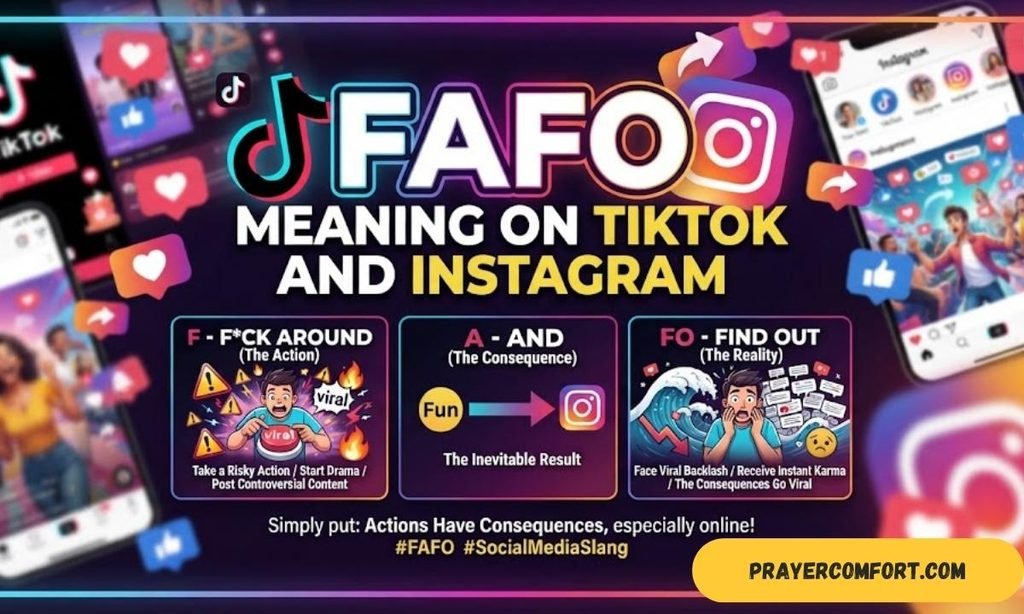
For example, a TikTok video might show someone attempting a dangerous-looking challenge and failing.
A commenter might write:
“FAFO 😭”
In this situation, the commenter may be joking about the predictable result.
On Instagram, FAFO can appear in:
- Reels comments
- Story captions
- Meme posts
- Reaction posts
- Humorous videos
- Discussions and arguments
The surrounding content is important because the phrase can range from playful to confrontational.
FAFO in Social Media Comments
| Comment | Likely meaning | Tone |
| “FAFO 😂” | Someone made a silly choice | Playful |
| “Well… FAFO.” | The result was predictable | Sarcastic |
| “He was warned. FAFO.” | Someone ignored warnings | Critical |
| “Keep pushing. FAFO.” | Stop before things get worse | Serious |
| “Classic FAFO moment.” | Someone experienced an expected consequence | Humorous |
In heated online conversations, FAFO can sometimes sound threatening. However, you shouldn’t automatically assume that every use is a literal threat. The full context matters.
What Does FAFO Mean in Real Life?
Although FAFO is strongly associated with internet slang, people also use it in everyday speech.
Someone might say it after a friend ignores advice or knowingly takes an unnecessary risk.
For example:
“I told him not to drive that fast. He did it anyway. FAFO.”
Here, the speaker is pointing out the connection between the person’s decision and its result.
The expression can also be used when someone repeatedly ignores personal boundaries.
For example:
“He keeps pushing her buttons. Eventually, he’s going to FAFO.”
In this context, the speaker means that the person may eventually face a response because they continued despite being warned.
Real-Life Uses of FAFO
You may hear FAFO when people discuss:
- Friendship
- Dating
- Arguments
- Workplace situations
- Sports
- Everyday decisions
- Personal boundaries
The basic pattern is usually:
Someone does something → They receive a warning → They ignore it → A consequence follows.
Is FAFO a Warning, Threat, or Joke?
FAFO can function as a warning, joke, sarcastic comment, or threat, depending on how it is used.
FAFO as a Warning
When used as a warning, FAFO can mean:
“Don’t continue because you may not like what happens next.”
For example:
“I’ve asked you three times to stop. FAFO.”
This sounds serious because it suggests that continued behavior could lead to consequences.
FAFO as a Joke
Friends often use FAFO to tease someone about a harmless mistake.
For example:
“You ate the whole bag of spicy chips. FAFO 😂”
The person isn’t necessarily being threatened. The speaker is joking that the decision may soon be regretted.
FAFO as a Threat
In some situations, FAFO can have a threatening or confrontational tone.
For example:
“Keep messing with me and FAFO.”
Here, the wording can imply that continued behavior could lead to retaliation.
The context is important. The acronym by itself doesn’t always reveal the speaker’s exact intention.
| Keep Reading These Topics |
| LYKYK Meaning: The Secret Slang Explained in 2026 |
| Audiodisplayed Meaning: Discover What It Really Means |
FAFO Examples in Texting and Online Conversations
Here are some simple examples that show how the slang works.
Example 1: A Friend Ignores Advice
Person A: “I told him not to drive that fast.”
Person B: “He never listens. FAFO.”
Meaning: He ignored the advice and may now have to deal with the consequences.
Example 2: A Playful Food Challenge
Person A: “I just ate the world’s hottest wings.”
Person B: “Bro… FAFO 😂”
Meaning: The friend is joking that the person may soon regret eating extremely spicy food.
Example 3: Someone Starts an Argument
Person A: “He kept insulting everyone in the comments.”
Person B: “Then people started responding.”
Person A: “FAFO.”
Meaning: The person provoked others and eventually received pushback.
Example 4: Ignoring a Deadline
Person A: “She knew the project was due Friday.”
Person B: “And she started it Friday morning?”
Person A: “Yep. FAFO.”
Meaning: The speaker believes the person’s poor planning led to predictable problems.
Example 5: Crossing a Boundary
Person A: “I told him not to bring that up again.”
Person B: “And he did?”
Person A: “Yep.”
Person B: “Sounds like he’s about to FAFO.”
Meaning: The person may face consequences for ignoring a clear boundary.
What Does FAFO Mean in a Meme?
The FAFO meaning in memes usually centers on predictable or immediate consequences.
A typical FAFO meme follows this pattern:
Someone takes a risk → ignores a warning → something goes wrong → people respond with “FAFO.”
The humor often comes from how obvious the outcome seems after the fact.
Imagine a meme showing someone repeatedly trying to balance on a chair despite being told to stop. The chair falls, and the caption says:
“FAFO.”
The joke focuses on the predictable chain of events.
Common FAFO Meme Themes
FAFO memes often involve:
- Bad decisions
- Overconfidence
- Failed experiments
- Reckless behavior
- Pranks that backfire
- Ignored warnings
- “I told you so” moments
- Unexpected consequences
The acronym works especially well in memes because four letters can summarize the entire situation.
Is FAFO Always Negative?
Not necessarily.
Although FAFO usually involves consequences, those consequences don’t have to be serious.
For example:
“You thought you could eat five burgers? FAFO.”
Or:
“You stayed up until 4 a.m. and have an 8 a.m. class. FAFO.”
Or:
“You said you could finish the whole project overnight. FAFO.”
These examples describe ordinary situations rather than serious consequences.
Still, FAFO generally carries a cautionary or negative flavor because the underlying message is that someone made a choice and now has to deal with its result.
How to Use FAFO Correctly
FAFO is best suited to informal communication.
It can work naturally in casual conversations with friends, group chats, memes, and some social media comments.
Appropriate Situations
FAFO may fit in:
- Casual texting
- Group chats with friends
- Informal social media comments
- Memes
- Private conversations
- Humorous online discussions
Situations to Avoid
It’s generally better to avoid FAFO in:
- Formal business emails
- Job applications
- Academic assignments
- Professional presentations
- Customer service messages
- Official workplace communication
- Situations where profanity may offend someone
The full phrase contains the F-word, so shortening it to four letters doesn’t completely remove its vulgar nature.
A Simple Rule
If you wouldn’t feel comfortable saying “Fuck Around and Find Out” in a particular setting, don’t assume that using FAFO automatically makes it appropriate.
The abbreviation may hide the profanity visually, but many people already know exactly what it means.
How to Respond When Someone Says FAFO
Your response should depend on the person’s tone and the situation.
If They’re Clearly Joking
You can respond playfully:
- “Guess I found out.”
- “Fair enough 😂”
- “Worth the risk.”
- “No regrets.”
- “Lesson learned.”
If They’re Giving You a Warning
A calm response might be:
- “I get your point.”
- “Message received.”
- “Understood.”
- “Fair warning.”
- “I’ll keep that in mind.”
If You’re Unsure What They Mean
You can simply ask:
“What do you mean by FAFO?”
There’s nothing wrong with asking. Slang can change depending on the community and context.
If the Message Seems Aggressive
If FAFO appears in a hostile conversation, avoid escalating the situation.
You could respond:
“I’m not looking for an argument.”
Or:
“Let’s keep this conversation respectful.”
The goal is to understand the tone before reacting.
FAFO vs. Similar Expressions
Several English expressions communicate a similar idea, but they don’t have exactly the same tone.
| Expression | Basic meaning | Typical tone |
| FAFO | Risky behavior can bring consequences | Blunt, vulgar, informal |
| Actions have consequences | Choices produce results | Neutral |
| You reap what you sow | Actions eventually affect you | Proverbial |
| You made your bed, now lie in it | You must live with your choices | Idiomatic |
| Play stupid games, win stupid prizes | Foolish behavior leads to poor outcomes | Sarcastic |
| What goes around comes around | Actions may eventually return to you | Reflective |
| Don’t test me | Stop pushing someone’s limits | Warning |
FAFO vs. “Actions Have Consequences”
Both expressions communicate a similar basic idea, but the tone is very different.
“Actions have consequences” is neutral and can be used in many settings.
“FAFO” is much more blunt, informal, and emotionally charged.
FAFO vs. “You Reap What You Sow”
“You reap what you sow” has a traditional and reflective tone. It often refers to the longer-term effects of someone’s choices.
FAFO is generally more immediate and direct.
Compare:
“Your actions have consequences.”
with:
“Keep pushing and you’ll find out.”
Both communicate cause and effect, but FAFO carries much more attitude.
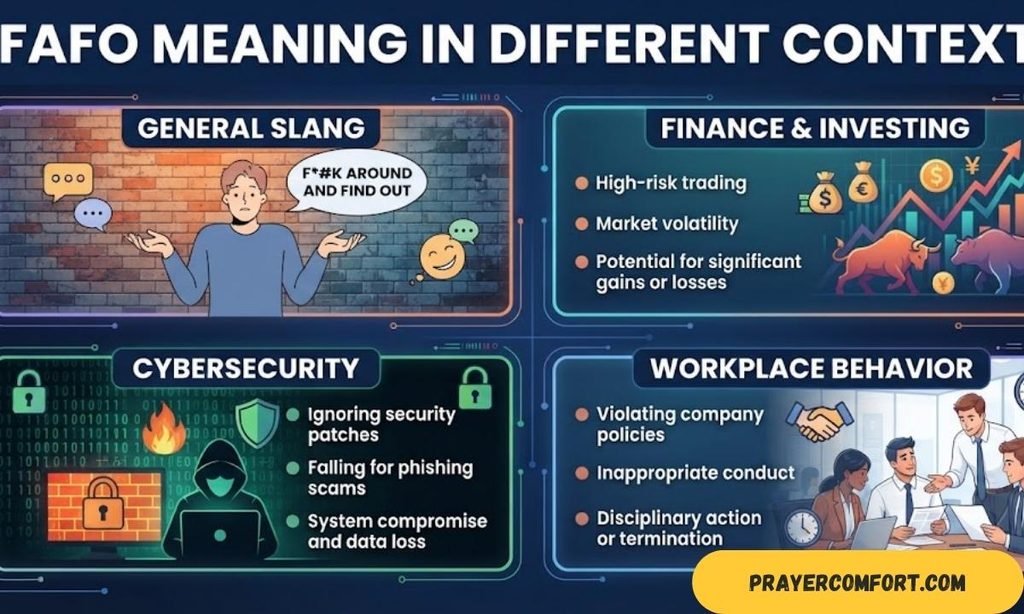
FAFO Meaning in Different Contexts
The meaning can shift depending on who uses it and where you see it.
FAFO From a Friend
It is often casual or humorous.
“You ignored my advice. FAFO.”
The friend may simply mean:
“I warned you.”
FAFO From a Stranger
The tone can be harder to interpret.
It could be a joke, criticism, warning, or something more confrontational. Look at the surrounding conversation before deciding what the person means.
FAFO From a Romantic Partner
The meaning depends heavily on the relationship and situation.
A playful message might be:
“You ate my leftovers? FAFO 😂”
But a statement about repeatedly crossing boundaries may sound much more serious.
FAFO in a TikTok Comment
On TikTok, FAFO often describes someone experiencing the consequences of a risky or questionable decision.
FAFO in an Instagram Caption
Someone may use FAFO to make a bold statement about taking risks, making choices, or standing up for themselves.
The rest of the caption usually provides the context.
FAFO During an Argument
This is one of the situations where the phrase can become especially confrontational.
For example:
“Keep talking. FAFO.”
Depending on the circumstances, this may be interpreted as a serious warning.
FAFO in Online Discussions
People may use FAFO when they believe someone is experiencing the consequences of their own actions.
However, online discussions often lack context, so it’s better not to automatically assume the strongest possible interpretation.
Is FAFO Appropriate to Use?
Whether FAFO is appropriate depends on your audience, setting, and intended meaning.
| Situation | Appropriate? | Reason |
| Private joke with close friends | Usually | Informal setting |
| Funny meme comment | Usually | Common slang context |
| Casual group chat | Usually | Familiar audience |
| Public social media post | Maybe | Audience varies |
| Workplace message | Usually not | Can sound unprofessional |
| Formal email | No | Contains profanity |
| Academic writing | No | Informal slang |
| Serious conflict | Be careful | May sound threatening |
| Conversation with strangers | Be cautious | Tone can be misunderstood |
The safest approach is simple:
Know your audience.
If you’re communicating professionally, a cleaner phrase such as “actions have consequences” is usually more appropriate.
Instead of:
“FAFO.”
you could say:
“Actions have consequences.”
Or:
“You may have to deal with the results of that decision.”
The basic idea remains, but the tone is much less aggressive.
FAFO and the Idea of Consequences
At its core, FAFO expresses a simple idea: choices can produce consequences.
People often use the phrase when they believe someone has enough information to make a different decision.
The typical situation looks like this:
Someone was warned.
They knew there was a risk.
They chose to continue.
Then they experienced the result.
In that sense, FAFO can be understood as:
“You knew what you were doing. Now you’re dealing with the outcome.”
This explains why the expression appears in conversations about personal responsibility.
However, real-life situations aren’t always that straightforward. Sometimes people face consequences they couldn’t reasonably predict.
For that reason, seeing someone comment “FAFO” doesn’t automatically mean the person deserved whatever happened. It reflects the commenter’s interpretation of the situation.
Case Study: Understanding FAFO Through One Situation
Consider a fictional example.
A person receives several warnings that a hiking trail becomes dangerous during heavy rain. They decide to go anyway. Later, the trail becomes muddy, and they have difficulty getting back.
Someone watching might say:
“They were warned. FAFO.”
The phrase suggests that the person knowingly accepted a risk.
Now change the situation.
Suppose the person checked the weather before leaving, but an unexpected storm suddenly developed. In that case, calling the situation FAFO would be less straightforward because they didn’t knowingly ignore an obvious warning.
This example shows why context matters.
FAFO doesn’t simply mean:
“Something bad happened.”
It is closer to:
“You took the risk or ignored the warning, and now you’re experiencing the result.”
FAFO Meaning: Key Facts to Remember
Here are the main things to remember about FAFO:
- FAFO stands for “Fuck Around and Find Out.”
- It is a slang acronym rather than formal English.
- It generally refers to facing consequences after risky, careless, or provocative behavior.
- It can be used as a warning, joke, sarcastic comment, or threat.
- The FAFO meaning in text depends heavily on context.
- On social media, it often describes predictable or humorous consequences.
- The phrase contains profanity even when abbreviated.
- It is generally unsuitable for formal or professional writing.
- Similar expressions include “actions have consequences” and “you reap what you sow.”
- Context is essential because FAFO can sound playful in one situation and confrontational in another.
Conclusion
FAFO is a popular slang abbreviation that stands for “Fuck Around and Find Out.” It describes the idea that people may eventually face consequences after taking risks, ignoring warnings, provoking others, or making careless choices.
You may see FAFO in texts, TikTok comments, Instagram captions, memes, online discussions, and everyday conversations. Its tone can vary significantly. Between friends, it may be nothing more than a joke, while during an argument, it can sound like a serious warning.
Because the phrase contains profanity, FAFO is best kept to informal situations rather than professional or formal communication.
The simplest way to understand the FAFO meaning in text is:
You made a choice, took the risk, and now you’re finding out what happens.

Ethan is a passionate content creator and SEO specialist with 2 years of hands-on experience in crafting compelling digital narratives.A peaceful space to find daily prayers, uplifting blessings, and spiritual inspiration to brighten your life.

1 thought on “FAFO Meaning: The Shocking Slang Explained Clearly ”