
You spotted a boat, a life ring, or maybe a floating marker in the water, and now you need to write about it. Your fingers hover over the keyboard. Is it buoy? Or is it bouy? You type it one way, it looks wrong. You type it the other way, it still looks wrong. That is the buoy or bouy trap, and almost everyone falls into it at least once.
Here is the short version so you are not left hanging: buoy is the correct spelling. Bouy is a common misspelling with no dictionary standing at all. Now let’s clear up why this word trips up so many smart people, and how you can spell it correctly every single time from now on.
Buoy
Buoy is a real, standard English word. It appears in every major dictionary, from Merriam-Webster to the Oxford English Dictionary. It refers to a floating object anchored in water, usually used to mark a channel, warn of danger, or support something on the surface.
Bouy
Bouy is not a word. It does not appear in any recognized dictionary. It is simply a misspelling that happens because people spell the word the way it sounds rather than the way it is actually written.
Buoy or Bouy – Quick Answer
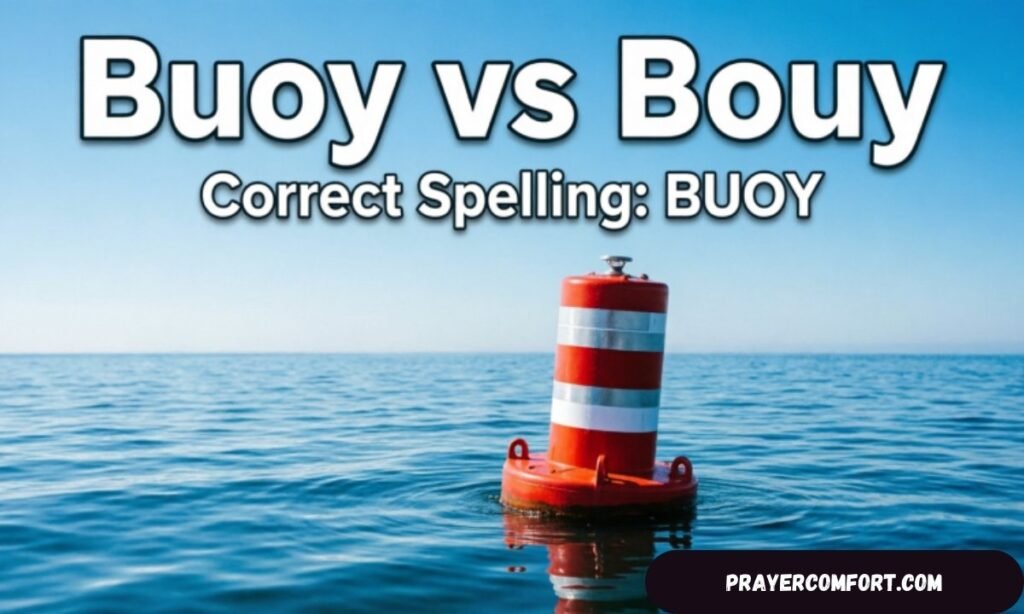
The correct spelling is buoy, always. There is no version of English, formal or casual, British or American, where “bouy” is accepted. If you remember nothing else from this article, remember that.
Simple Examples
- Correct: The sailor spotted a red buoy near the harbor entrance.
- Incorrect: The sailor spotted a red bouy near the harbor entrance.
- Correct: Her positive attitude helped buoy the team’s spirits.
- Incorrect: Her positive attitude helped bouy the team’s spirits.
Quick Comparison
| Spelling | Correct? | Found in Dictionaries? | Common Usage |
| Buoy | Yes | Yes | Standard spelling used everywhere |
| Bouy | No | No | Frequent typo, never accepted |
Buoy or bouy pronunciation
This is really where the confusion starts. In American English, buoy is usually pronounced like “BOO-ee,” two syllables. In British English, it often sounds closer to a single syllable, similar to the word “boy.”
That British pronunciation is exactly why so many people write “bouy.” Their ear tells them the word rhymes with boy, so their hand tries to make the spelling match that sound. Unfortunately, English spelling rarely rewards that kind of logic.
What Does “Buoy” Mean?
At its core, a buoy is a floating device anchored to the seabed or riverbed. Sailors, fishermen, and coast guards use buoys to mark safe channels, flag hazards like rocks or shipwrecks, or hold navigational lights and bells in place.
Buoy also works as a verb. When something “buoys” you up, it lifts your mood or keeps you afloat, literally or emotionally. A good performance review can buoy your confidence just as a life vest buoys your body in water.
Is “Bouy” a Real Word?
No, and this needs to be said plainly because search engines are full of half answers. “Bouy” has never been listed as an alternate spelling in any English dictionary, past or present. It is not archaic, not regional, not informal. It is simply incorrect.
Some people assume that because a misspelling is common, it eventually becomes acceptable, the way “alright” slowly earned informal acceptance. That has not happened with bouy, and there is no sign it will.
The Origin of Buoy
The word buoy traces back to Middle Dutch “boeye” or Old French “buie,” both connected to the idea of a chain or fetter, since early buoys were literally objects tied down in the water. Some language historians also link it to the Latin “boia,” meaning a collar or restraint.
Interestingly, ropes and chains show up in old maritime and even biblical descriptions of anchoring vessels, since keeping something fixed in open water is a challenge as old as sailing itself. Ancient sailors used anchored floats long before the modern spelling of buoy ever existed, tying markers to reefs and shallow points to warn other ships.
The word evolved through centuries of maritime trade between Dutch, French, and English sailors, which is part of why its spelling looks a little unusual compared to how it sounds.
Why Do People Misspell Buoy as Bouy?
Three reasons show up again and again.
First, English spelling does not always match pronunciation, and buoy is a textbook example. Second, the “uoy” letter combination is rare. Most people can only think of one or two other English words that use it, so their brain has nothing to compare it against.
Third, autocorrect and spellcheck tools sometimes fail to catch it because “bouy” looks close enough to real words that some systems let it slide.
British English vs American English Spelling (Buoy vs Bouy)
Is There Any Difference?
No. This is one of the rare cases where British and American English fully agree. Both varieties spell the word “buoy.” The only real difference is pronunciation, not spelling.
Comparison Table
| Feature | American English | British English |
| Spelling | Buoy | Buoy |
| Pronunciation | BOO-ee | Often closer to “boy” |
| Dictionary Status | Standard | Standard |
| “Bouy” Accepted? | No | No |
Buoy or bouy slang
There is no slang version of this word where “bouy” becomes acceptable. You will see it misspelled constantly in casual social media captions, boating forums, and text messages, but that is informal error, not slang.
Slang usually involves an intentional twist on a word. This is just a spelling slip that spread because it looks phonetically reasonable.
Which Spelling Should You Use?
Use “Buoy” When:
- Referring to a floating marker or navigational device in water
- Describing something that lifts or supports morale, confidence, or mood
- Writing in any formal, academic, professional, or published context
- Talking about maritime safety equipment like mooring buoys or life buoys
Never Use “Bouy”
There is no context, casual or formal, spoken or written, where “bouy” is the right call. If you catch yourself typing it, stop and swap in “buoy” before you hit send.
| Don’t Miss These Articles |
| Bellies or Bellys: Which Spelling Is Actually Correct? |
| RSVP Meaning: Discover What It Really Means |
| Endeavor Meaning: Discover the True Meaning Explained |
Buoy as a Noun and Verb
Buoy (Noun)
As a noun, buoy refers to a physical object, usually anchored in water. Example: “The channel markers use yellow buoys to guide boats safely.”
Buoy (Verb)
As a verb, buoy means to keep something afloat or to lift spirits. Example: “The unexpected bonus buoyed the whole office after a tough quarter.”
Common Expressions Using Buoy
- “Buoy someone’s spirits”
- “Buoyed by good news”
- “Stay buoyant” (related adjective form)
- “A buoy marks the reef”
Pronunciation of Buoy: Why It Confuses People
Few English words create as much pronunciation disagreement as buoy. In the United States, most speakers say “BOO-ee.” In parts of the United Kingdom, Australia, and elsewhere, it often sounds like a one-syllable word closer to “boy.”
This split matters because it directly feeds the spelling mistake. If your ear hears “boy,” your hand naturally wants to write something that looks like boy with an extra letter tacked on, which is exactly how “bouy” gets created in people’s minds.
Common Mistakes with Buoy or Bouy
Mistake 1: Spelling by Sound
English is not a purely phonetic language. Buoy is proof of that. Sounding it out will not save you here, since the spelling does not match either common pronunciation cleanly.
Mistake 2: Assuming “Bouy” Is an Alternative Spelling
Some writers assume dictionaries just have not caught up yet, similar to how some informal spellings eventually get added. That has never happened with bouy, and dictionaries show no movement in that direction.
Mistake 3: Using Incorrect Past Tense Forms
The correct past tense of the verb is “buoyed,” not “bouyed.” Example: “Her speech buoyed the audience’s confidence heading into the vote.”
Mistake 4: Mixing Up Buoy with Boy
Because of the British pronunciation, some writers accidentally type “boy” when they mean “buoy,” especially when typing quickly. Spellcheck usually will not flag this, since “boy” is a completely valid word on its own, just the wrong one in context.
Buoy or Bouy in Everyday Examples

Emails
“Please confirm the buoy placement schedule before the harbor inspection on Friday.”
News
News reports about ocean rescues, weather buoys, or shipping lanes almost always use the correct spelling, since wire services and editors catch typos before publication.
Social Media
Casual boating and fishing communities online are where “bouy” shows up most often, usually in captions written quickly without a second glance.
Formal Writing
Academic papers, government maritime documents, and technical manuals always use “buoy,” never the misspelled version, since these documents go through editing and proofreading.
Buoy restaurant
Some restaurants, especially seafood spots near coastlines, use “Buoy” as part of their name to lean into a nautical theme. If you are searching for one, double check the spelling on their actual signage or website, since business names sometimes get typed incorrectly in directories or reviews.
Buoy water
“Buoy water” is not a standard technical term, but people sometimes use it casually to describe the water surrounding a marked buoy, such as a swim buoy marking a safe swimming zone at a beach.
Maritime Communication
In official maritime radio and navigation charts, buoys are referred to by specific names like “channel buoy,” “mooring buoy,” or “safe water buoy,” and the spelling is always standardized as “buoy” across international shipping documentation.
Buoy in Common Phrases and Maritime Terms
Sailors and coast guard authorities use several buoy related terms regularly:
- Channel buoy: marks the safe path through a waterway
- Mooring buoy: allows boats to anchor without dropping their own anchor
- Life buoy: a ring shaped flotation device used in emergencies
- Weather buoy: collects ocean and atmospheric data for forecasting
Each of these terms uses the same correct spelling, reinforcing that “buoy” is the only accepted form across every specialized use case.
Buoy or Bouy – Google Trends & Usage Data
Search data consistently shows that “bouy” receives a meaningful share of monthly searches, often tens of thousands, purely because people are unsure how to spell the word correctly. This pattern is common with words that have unusual letter combinations.
Despite the search volume for the misspelling, actual published usage in books, news, and professional writing overwhelmingly favors “buoy,” which confirms that the misspelling exists mainly in search behavior and casual typing, not in accepted writing.
Comparison Table: Buoy vs Bouy
| Category | Buoy | Bouy |
| Dictionary Listed | Yes | No |
| Correct Spelling | Yes | No |
| Used in Publishing | Always | Never |
| Common Typo | No | Yes |
| Search Volume | High | Moderate to high |
How to Remember the Correct Spelling
Try this simple trick: think of the phrase “buy a buoy,” and notice how both words contain “uy” or “uoy” patterns close together. Another trick is remembering that buoy contains the word “buy” hidden inside it, just with an extra O. If you can spell “buy,” you can spell “buoy” by adding one letter.
Visual learners can also picture the shape of a buoy itself, round and bobbing, and connect that image to the round shape of the letter O sitting inside the word.
Buoy vs Similar Confusing Words
Buoy vs Boy
“Boy” refers to a young male person. “Buoy” refers to a floating marker or the act of lifting spirits. They are unrelated in meaning, even though British pronunciation makes them sound alike.
Buoyant vs Buoy
“Buoyant” is the adjective form, describing something capable of floating or someone who has a cheerful, resilient attitude. Example: “The economy showed buoyant growth despite earlier concerns.”
Buoy vs Beacon
A buoy floats on water and is usually anchored in place, while a beacon is typically a fixed structure, often on land or a platform, used for signaling or guidance. Both serve navigational purposes, but they are physically different types of markers.
Frequently Asked Questions
Is it buoy or bouy?
It is always “buoy.” “Bouy” is a misspelling that does not appear in any standard dictionary.
How do British pronounce buoy?
British English speakers typically pronounce buoy closer to a single syllable, sounding similar to “boy.”
What does buoy mean?
As a noun, buoy refers to a floating object anchored in water for navigation or safety. As a verb, it means to keep something afloat or to lift someone’s spirits.
How do Australians say buoy?
Australian English typically follows a pronunciation closer to the British style, sounding similar to “boy,” though some regional variation exists.
Final Verdict: Buoy or Bouy?
The correct spelling is buoy, without exception. Bouy is a widespread typo caused by pronunciation confusion, not a recognized alternative. Once you connect the spelling to the hidden word “buy” inside it, the mistake becomes much harder to make.
Next time you are writing about a floating marker or need a word for lifting spirits, you will know exactly which version to type, and you will type it right the first time.

Ethan is a passionate content creator and SEO specialist with 2 years of hands-on experience in crafting compelling digital narratives.A peaceful space to find daily prayers, uplifting blessings, and spiritual inspiration to brighten your life.

1 thought on “Buoy or Bouy? The Correct Spelling Revealed”