
Ever typed “layed out” and then paused, wondering if that little red squiggly line is judging you? You’re not alone. This mix up trips up even confident writers.
Here’s the short answer before anything else: “laid out” is correct, and “layed out” is always wrong, in every context, every tense, every sentence. Let’s clear up why, once and for all.
Understanding “Laid Out”
“Laid out” comes from the verb lay, which means to place something down carefully or to arrange something in a planned way. The past tense and past participle of “lay” is “laid,” never “layed.”
So when you’re describing something that was arranged, planned, or physically placed somewhere, “laid out” is the phrase you want.
Meaning of Laid Out
“Laid out” has a few common meanings depending on context:
- Arranged or organized: “The report was laid out clearly.”
- Physically placed down: “She laid out the blanket on the grass.”
- Planned in detail: “The manager laid out the project timeline.”
- Knocked unconscious (informal): “One punch and he was laid out.”
Notice how the core idea stays the same. Something goes from unorganized or upright to arranged, flat, or planned.
Examples of Correct Usage
Here’s how “laid out” fits naturally into everyday sentences:
- The architect laid out the blueprint on the table.
- Our vacation itinerary is laid out day by day.
- He laid out his clothes for the interview the night before.
- The garden was laid out in neat rows.
Each example shows deliberate placement or planning, which is exactly what “lay” is built to express.
Read More Articles
Verbage or Verbiage? Master the Difference Fast
Naive or Nieve? The Correct Spelling Revealed 2026
Keep Past Tense: Master It With Easy Examples 2026
Laid Out Definition
In dictionary terms, “laid out” is the past tense and past participle form of the phrasal verb “lay out.” It means to arrange, spread, display, or plan something with intention.
Merriam Webster and Oxford dictionaries both confirm the same spelling: laid, not layed. There is no accepted dictionary entry anywhere for “layed” as a standalone word.
Laid Out Meaning
Beyond the dictionary definition, “laid out” carries a sense of order. Think of a table set for dinner, a business plan on a whiteboard, or clothes arranged for the morning. In each case, something has been positioned with purpose.
This is different from just placing something randomly. “Laid out” implies thought went into the arrangement.
Why “Layed Out” Is Incorrect
Here’s where a lot of confusion starts. English speakers often assume that adding “ed” to a verb always creates the past tense, like “play” becomes “played” or “stay” becomes “stayed.”
But “lay” doesn’t follow that pattern. It’s an irregular verb, and its past tense breaks the usual rule entirely.
The correct irregular forms are:
- Lay (present) → Laid (past) → Laid (past participle)
“Layed” simply doesn’t exist as a recognized English word, no matter how natural it might sound after typing quickly.
Laid out or layed out grammar
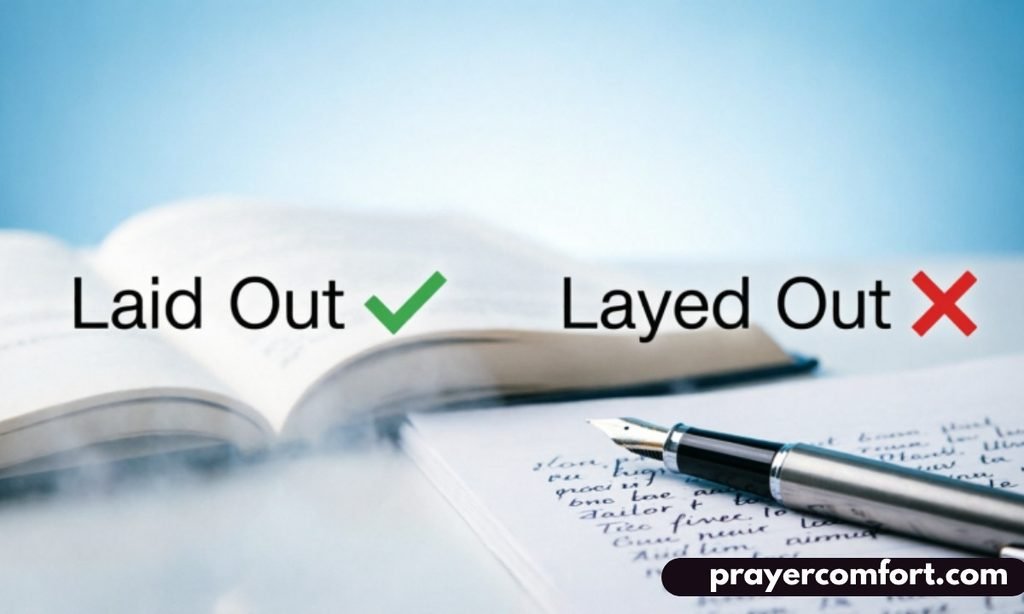
From a grammar standpoint, this comes down to verb conjugation. “Lay” is a transitive verb, meaning it needs an object. You lay something down, you don’t just lay.
Because “lay” is irregular, English rules for regular past tense formation don’t apply here. That’s the entire root of the confusion, and once you know it, the mistake becomes much easier to avoid.
Laid Out vs Layed Out – Quick Comparison Table
| Word | Correct? | Part of Speech | Example |
| Laid out | Yes | Past tense/participle of “lay out” | She laid out the documents. |
| Layed out | No | Not a real word | ❌ Never correct |
Simple, direct, and something you can screenshot for later.
Tips to Remember the Difference
Struggling to keep it straight? Try these quick mental tricks:
- Replace “laid” with “placed.” If the sentence still makes sense, “laid” is correct.
- Remember: “lay, laid, laid,” just like “pay, paid, paid.”
- If you’re tempted to write “layed,” picture a red pen slashing through it. That mental image sticks.
Once the pattern clicks, you’ll stop second guessing it entirely.
Laid out or layed out in the sun
This phrase trips people up constantly because it feels casual, almost like slang. But the rule doesn’t change based on context.
Correct: “I laid out in the sun all afternoon.” Incorrect: “I layed out in the sun all afternoon.”
Even in relaxed, everyday speech, “laid” stays the same. Sunbathing doesn’t get a grammar exception.
Regional Notes: British vs American English
Good news here. This isn’t one of those British versus American spelling battles like “colour” and “color.”
Both British and American English agree: “laid” is correct, “layed” is not. This is a universal English rule, not a regional dialect difference, which makes it even easier to remember.
Common Mistakes
People usually stumble in a few predictable ways:
- Confusing “lay” with “lie” (lying down versus laying something down)
- Assuming “lay” follows regular verb rules
- Autocorrect sometimes failing to catch “layed” in casual texting
- Mixing up “laid” with “lied,” which actually means told an untruth
Knowing these patterns helps you catch the mistake before hitting send.
Real Life Examples
Seeing correct usage in real contexts helps cement the rule:
- News headline: “City officials laid out a new plan for downtown parking.”
- Workplace email: “I’ve laid out the quarterly numbers in the attached sheet.”
- Casual text: “We just laid out on the beach all day, so relaxing.”
- Instruction manual: “The steps are laid out below in order.”
Across formal writing, business communication, and casual conversation, the spelling never shifts.
Laid Out Usage Tips
To use “laid out” confidently and naturally:
- Use it when describing plans, layouts, or spread out items.
- Pair it with words like “clearly,” “carefully,” or “neatly” for extra clarity.
- Avoid using it interchangeably with “lied,” which relates to dishonesty, not placement.
- When in doubt, swap in “arranged” as a quick mental check.
Laid out or layed out past tense
Since “laid” already functions as both past tense and past participle, there’s no separate past tense form to worry about. That means:
- Present: lay out
- Past: laid out
- Past participle: laid out
No matter which tense your sentence sits in, “layed” never enters the picture.
Comparison Table: Lay vs Lie vs Laid
This is where most people actually get stuck, since “lay” and “lie” look and sound similar but mean different things.
| Verb | Meaning | Present | Past | Past Participle |
| Lay | To place something down | Lay | Laid | Laid |
| Lie | To recline or rest | Lie | Lay | Lain |
| Laid | Past form of “lay” | (used as verb form) | Laid | Laid |
Notice that “lay” is actually the past tense of “lie.” That overlap is exactly why so many people mix things up in the first place.
Fun Memory Trick
Here’s a quick trick that sticks surprisingly well. Chickens lay eggs, they don’t “layed” eggs, and they definitely don’t “lie” eggs either. If a chicken can get it right, so can you.
Another fun one: think of “laid” like “paid.” You paid a bill, you laid a table. Same irregular pattern, same easy fix.
FAQs (People Also Ask Style)
Is it laid out or layed out?
“Laid out” is correct. “Layed out” is a common misspelling and isn’t recognized in standard English dictionaries.
What does it mean by laid out?
“Laid out” means something was arranged, planned, or physically placed in a specific order or position, such as a layout, plan, or display.
Which is correct, layed or laid?
“Laid” is correct. “Layed” is never correct in any tense or context, since “lay” is an irregular verb.
What does laid mean?
“Laid” is the past tense and past participle of “lay,” meaning to place something down or arrange it deliberately.
Final Thoughts
At the end of the day, this comes down to one simple irregular verb pattern. “Lay” becomes “laid,” never “layed,” in every sentence, every tense, and every region of the English speaking world.
Once you connect “lay” to “pay” and “laid” to “paid,” the confusion tends to disappear for good. So next time you’re tempted to type “layed,” picture that chicken laying an egg, and let it remind you which spelling actually belongs in your writing.

Ethan is a passionate content creator and SEO specialist with 2 years of hands-on experience in crafting compelling digital narratives.A peaceful space to find daily prayers, uplifting blessings, and spiritual inspiration to brighten your life.

2 thoughts on “Laid Out or Layed Out? The Correct Answer Revealed”