
If you’ve typed this word and then stared at it, unsure whether it looks right, you’re dealing with one of English’s sneakiest silent letters. The confusion is understandable: the word is pronounced “naw,” so both “knaw” and “gnaw” seem like fair guesses.
Here’s the short version: gnaw is the correct spelling. Knaw isn’t recognized in standard dictionaries, and using it in place of gnaw is treated as a misspelling in American English.
Knaw or Gnaw – Quick Answer
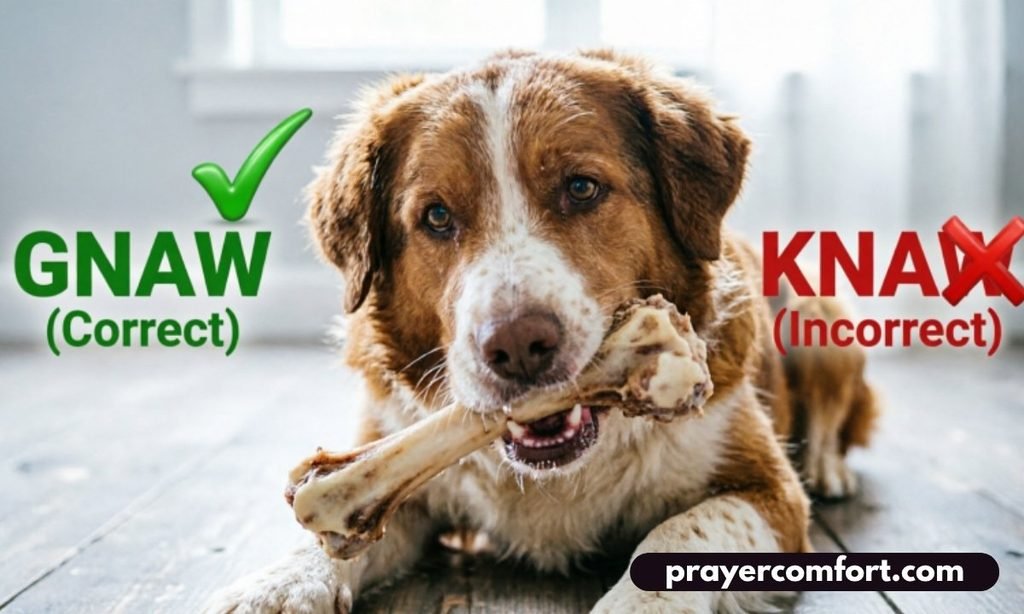
Gnaw is the only standard spelling. It’s a verb meaning to bite or chew something repeatedly, to wear something away slowly, or to describe a worry that keeps bothering someone over time.
Knaw is not a recognized word; it’s a phonetic misspelling that happens because the “g” in gnaw is silent. If you remember nothing else from this article, remember this: say “naw,” write “gnaw.”
Knaw Meaning (Is It a Real Word?)
Knaw has no accepted meaning in modern English. It doesn’t appear in Merriam-Webster, Oxford, or Cambridge as a standard entry, and style guides on both sides of the Atlantic treat it purely as a spelling error. Some very old or regional texts show “knaw” as a variant spelling from centuries ago, but that history doesn’t make it correct for anyone writing today. If you’re searching for what “knaw” means, the honest answer is that whoever wrote it almost certainly meant gnaw.
The Origin of Knaw or Gnaw
The word traces back to the Old English verb gnagan, meaning to bite or gnash. That root came from a broader family of Germanic words, several of which still show up in English today with the same silent-letter pattern, think of gnat, gnash, and gnome. As English pronunciation evolved, speakers stopped voicing the initial “g” in these words, but the spelling stuck. That’s why gnaw looks like it should start with a hard consonant sound but doesn’t.
Knaw was never part of that lineage. It looks plausible only because English already has a separate family of “kn-” words know, knee, knife, knight where the “k” is also silent. Your brain is essentially borrowing a spelling pattern from the wrong word family.
British English vs American English Spelling
This isn’t one of those cases where American and British English disagree. Unlike color/colour or realize/realise, gnaw is spelled identically in both varieties. Every major British and American dictionary lists gnaw as the standard verb, and knaw doesn’t appear as an accepted alternative in either.
Comparison Table
| Region | Correct Spelling | Notes |
| American English | gnaw | Standard in all contexts |
| British English | gnaw | Standard in all contexts |
| Any dialect form | knaw | Historical/nonstandard only, not used in modern writing |
Is KNAW a Word in Scrabble?
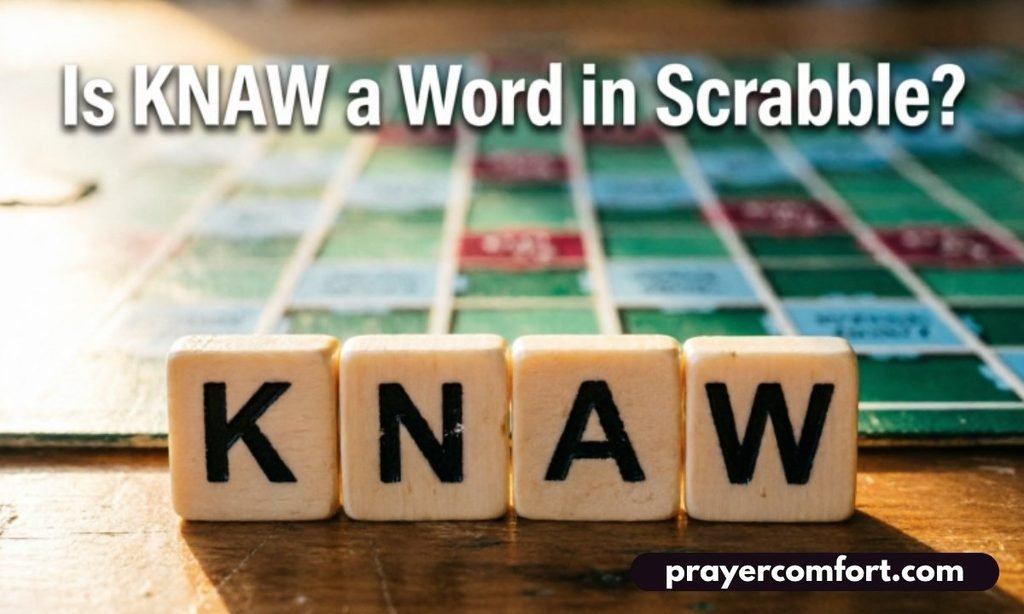
No. KNAW is not a valid word in either the Official Scrabble Players Dictionary or Collins Scrabble Words, so it won’t score you any points at the board. GNAW, on the other hand, is a valid Scrabble word worth checking before you play it, since its value depends on where your G and W land on the board. If you’re stuck with a K, N, A, and W in your rack, you’re better off looking for another combination.
Which Spelling Should You Use?
Use gnaw in every situation casual texts, emails, essays, and formal reports. There’s no context, tone, or audience where knaw becomes acceptable. Unlike some spelling debates that depend on formality or region, this one has a single answer with no exceptions.
A simple way to lock it in: connect gnaw to its silent-g relatives. If you already spell gnat and gnash correctly, apply the same logic here. The “g” is silent, but it’s still part of the word.
Common Mistakes with Knaw or Gnaw
The most frequent mistake is writing “knaw” because the word sounds identical to “naw” or “gnaw” out loud, and the brain reaches for a familiar silent-letter pattern. Here’s how to tell the difference and fix it:
- Incorrect: The puppy started to knaw on my shoe.
- Correct: The puppy started to gnaw on my shoe. Why it’s wrong: “Knaw” borrows the silent-k pattern from words like know, but gnaw belongs to the silent-g family instead.
- Incorrect: Guilt kept knawing at her all night.
- Correct: Guilt kept gnawing at her all night. Why it’s wrong: Same root error: the writer is spelling the word the way it sounds rather than the way it’s actually written.
A quick memory trick: pair gnaw with gnat. If you can spell “gnat” without a second thought, you already know how to start “gnaw.”
Knaw or Gnaw in Everyday Examples

Emails
“Please gnaw through this backlog before Friday’s meeting” (used loosely to mean chip away at a task).
News
“Wildlife officials say beavers continue to gnaw through protective tree wraps along the riverbank.”
Social Media
“This deadline is literally gnawing at me rn 😩”
Formal Writing
“Persistent doubt about the merger’s terms began to gnaw at investor confidence throughout the quarter.”
Read Also : Undulating Kiss Meaning
Knaw or Gnaw Meaning in Context
Gnaw carries two related senses. The literal sense describes repeated biting or chewing, often by an animal a dog gnawing a bone, a rat gnawing through wiring, a beaver gnawing a tree trunk.
The figurative sense describes a feeling, thought, or problem that steadily wears at someone’s peace of mind, as in “regret gnawed at him for years.” Both uses share the same idea: something happening slowly and repeatedly, bit by bit, until it has a real effect.
Knaw or Gnaw – Search Trends & Usage Data
Searches comparing “knaw” and “gnaw” spike mainly because of how the word sounds rather than any real ambiguity in meaning. People type the phonetic version first, get an autocorrect flag or an uneasy feeling, and then search to confirm which spelling is standard. This pattern is common with other silent-letter words, and it explains why “knaw or gnaw” performs better as a search phrase than “gnaw meaning” alone; the confusion is about spelling, not definition.
Comparison Table: Knaw vs Gnaw
| Term | Correct? | Meaning | Typical Use | Example |
| Gnaw | Yes | To bite/chew repeatedly, or to trouble someone persistently | All writing contexts | “The dog gnawed the bone all afternoon.” |
| Knaw | No | None (misspelling of gnaw) | None avoid entirely | “The dog knawed the bone.” (incorrect) |
FAQs About Knaw or Gnaw
Is it knaw or gnaw?
It’s always gnaw. Knaw is not a standard English word in any modern dictionary, and gnaw is the only form accepted in American and British English alike.
What is meant by gnaw?
Gnaw means to bite or chew something repeatedly, often slowly wearing it away, such as a beaver gnawing a log. It’s also used figuratively for a worry or feeling that keeps bothering someone over time.
Is knaw a word?
Not in modern standard English. It shows up occasionally in old or dialectal writing, but current dictionaries and style guides treat it strictly as a misspelling of gnaw.
Which is correct: “naw” or “knaw”?
Neither is the word you likely want if you mean to bite or chew that word is gnaw. “Naw” is a separate, informal spelling used to represent a casual pronunciation of “no.”
Is “gnaw” a word?
Yes. Gnaw is a standard English verb recognized by every major dictionary, and it’s also valid in Scrabble.
How do you use gnaw?
Use gnaw as a verb, either literally (“Mice gnaw through cardboard”) or figuratively (“Anxiety gnawed at her before the interview”). It conjugates regularly: gnaw, gnawed, gnawing.
Conclusion
The rule here is short and has no exceptions: gnaw is correct, knaw is not. The confusion comes entirely from pronunciation; the silent “g” makes the word sound like it could start with a “k,” borrowing a pattern from a completely different family of words.
Once you connect gnaw to relatives like gnat and gnash, the spelling becomes easy to remember for good. Next time you reach for this word, in any context, write gnaw.

Ethan is a passionate content creator and SEO specialist with 2 years of hands-on experience in crafting compelling digital narratives.A peaceful space to find daily prayers, uplifting blessings, and spiritual inspiration to brighten your life.

2 thoughts on “Knaw or Gnaw: The Correct Spelling Revealed 2026”