
You hear the word all the time in interviews, therapy sessions, and team meetings, but the moment you try to type it, something feels off. Is it “repore” or “rapport”? The mix-up happens because the word doesn’t sound the way it’s spelled.
Here’s the short version: rapport is the only correct spelling. “Repore” is a phonetic guess that never made it into any English dictionary.
Repore or Rapport – Quick Answer
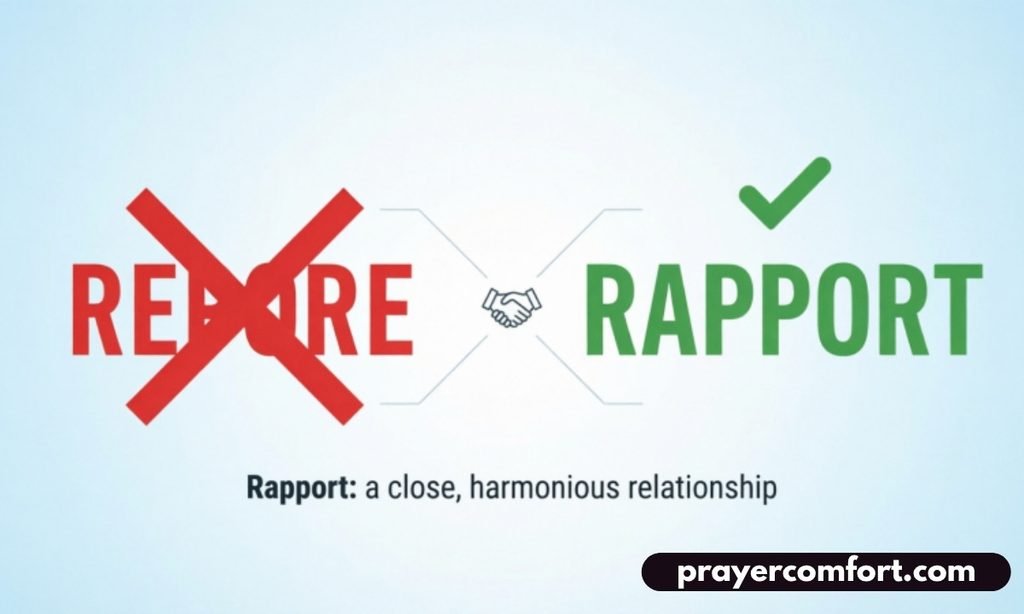
Rapport is correct. Repore is incorrect in every context, region, and style of writing.
Rapport means a close, comfortable relationship built on mutual trust and understanding. People search for “repore” because the word is pronounced ruh-POR, and English spelling doesn’t always match pronunciation, especially with words borrowed from French. If you remember one rule from this article, make it this one: whenever you’re describing a good connection with someone, write rapport, not repore.
The Origin of Repore or Rapport
Rapport entered English from French in the 17th and 18th centuries. In French, “rapport” relates to the verb rapporter, meaning to bring back or relate, and it carries the sense of a connection or relationship between two things or people. English absorbed the word along with its original French spelling, including the double p and the silent final t.
That silent t is the real source of the confusion. Since it isn’t pronounced, the word sounds like it ends in “pore,” which nudges writers toward the misspelling “repore.” “Repore” was never a genuine variant or an older form of the word. It’s simply a spelling that grew out of how the word sounds out loud, not how it was actually written.
Repore or Rapport Meaning
Rapport is a noun that describes a harmonious, trusting relationship in which people communicate easily and understand each other well. You can have rapport with a coworker, a doctor, a teacher, a customer, or a new acquaintance.
A simple working definition: rapport is the sense of ease and mutual understanding that lets two people connect naturally. It doesn’t require a deep or long-term relationship. You can build rapport with a stranger in a five-minute conversation if the exchange feels comfortable and genuine.
“Repore” has no accepted meaning in standard English. It isn’t a shortened form, a British variant, or an informal alternative. It’s simply a misspelling, and using it in writing signals a spelling error rather than a stylistic choice.
British English vs American English Spelling
Unlike words such as colour/color or organise/organize, rapport doesn’t change between British and American English. There’s no British spelling and no American spelling to choose between here.
- British English: rapport
- American English: rapport
- Australian and Canadian English: rapport
This makes rapport easier to remember once you know it, since you don’t have to think about which audience you’re writing for. The spelling stays fixed everywhere English is written formally.
Which Spelling Should You Use?
Always use rapport. There’s no situation, formal or casual, where “repore” is acceptable. That includes:
- Professional emails and reports
- Resumes and cover letters
- Academic essays
- Text messages and social media captions
- Customer service scripts
If your spell-checker underlines “repore,” trust it. The fix is always the same: swap in rapport.
A quick memory trick many writers use is breaking the word into parts: RA + PP + ORT. Saying it out loud in that broken-up rhythm helps the double p and the silent t stick in your memory.
Repore or Rapport in Relationship

Rapport shows up constantly in relationship language, whether that relationship is personal or professional. Building rapport with a partner, friend, or family member usually means developing a natural sense of trust and comfortable communication over time.
In dating and counseling contexts, people often talk about “having good rapport” with someone early on, meaning the conversation flows easily and both people feel understood. This is different from deeper commitment or long-term compatibility. Rapport is the foundation that makes those deeper connections possible, not the relationship itself.
Correct: “We had great rapport from the first date.” Incorrect: “We had great repore from the first date.”
Common Mistakes with Repore or Rapport
Most mistakes with this word fall into a few predictable patterns.
Spelling it phonetically. Because rapport ends in a silent t, writers often spell what they hear: repore, repor, rapor, or raport. None of these are correct.
Dropping the double p. The double p is easy to miss since it isn’t emphasized in speech. Writing “rapor” instead of “rapport” is a common shortcut error.
Confusing it with “report.” Rapport and report look similar on the page, but they mean completely different things. A report is a document or summary; rapport is a relationship.
Correct: “The manager reviewed the sales report.” Incorrect: “The manager reviewed the sales repore.”
A reliable way to avoid all of these errors is to slow down and picture the French spelling: r-a-p-p-o-r-t, with a silent t at the end, similar to words like depot or ballet.
Repore or Rapport in Everyday Examples
Seeing the word used correctly in different settings makes the spelling easier to remember.
Workplace: Correct: “She quickly built rapport with the new clients.” Incorrect: “She quickly built repore with the new clients.”
School: Correct: “Good teachers know how to establish rapport with students on the first day.” Incorrect: “Good teachers know how to establish repore with students on the first day.”
Text message: Correct: “loved chatting with you, we have such good rapport lol” Incorrect: “loved chatting with you, we have such good repore lol”
Healthcare: Correct: “The therapist worked to build rapport before discussing sensitive topics.” Incorrect: “The therapist worked to build repore before discussing sensitive topics.”
Repore or Rapport – Google Trends & Usage Data
Search interest for “repore” spikes regularly, which shows how many people genuinely aren’t sure how to spell this word before writing it down. That’s a strong signal that the confusion is driven by pronunciation rather than any real disagreement about spelling.
Despite the search volume around “repore,” it has never appeared as a recognized entry in Merriam-Webster, Oxford, or Cambridge dictionaries. Only “rapport” appears as a standard dictionary word, which confirms it’s the sole accepted spelling rather than one option among several.
Comparison Table: Keyword Variations
| Term | Correct? | Meaning | Typical Use |
| Rapport | Yes | A close, trusting relationship or connection | Standard spelling in all writing |
| Repore | No | No meaning; a misspelling of rapport | Should always be corrected to “rapport” |
| Repor | No | No meaning; a truncated misspelling | Should always be corrected to “rapport” |
| Raport | No | No meaning; a phonetic misspelling | Should always be corrected to “rapport” |
| Report | Yes (different word) | A written or spoken account of information | Used for documents and summaries, not relationships |
Frequently Asked Questions
Is it repour or rapport?
It’s rapport. “Repour” is another phonetic misspelling, likely influenced by the word “pour.” Only “rapport” appears in standard English dictionaries, and it’s the spelling to use in any formal or informal writing.
What does it mean to have good repore?
The intended word is “rapport.” Having good rapport with someone means you communicate easily, understand each other, and feel a natural sense of trust and comfort together. It’s commonly mentioned in the context of coworkers, teachers, therapists, and new relationships.
What is a repore?
“Repore” isn’t a real word, so it has no definition of its own. If you’re searching for this term, you almost certainly mean “rapport,” which refers to a positive, trusting connection between people.
How do you spell repore with someone?
There’s no correct way to spell “repore,” since the word itself is a misspelling. To describe a good connection with someone, write “rapport,” as in “I have great rapport with her.”
Conclusion
The confusion between repore and rapport comes down to one thing: rapport is a French loanword with a silent final letter, and English spelling doesn’t always follow the sound of a word. Rapport is correct in every dictionary, every region, and every writing context.
“Repore” is simply what your ear hears, not what your pen should write. Once you connect the spelling to its French roots, and remember that double p and silent t, the mistake tends to disappear for good.

Ethan is a passionate content creator and SEO specialist with 2 years of hands-on experience in crafting compelling digital narratives.A peaceful space to find daily prayers, uplifting blessings, and spiritual inspiration to brighten your life.

2 thoughts on “Repore or Rapport? The Correct Spelling Revealed (2026)”