
A poison tree tattoo is not the kind of design someone picks because it looks nice in a flash sheet. People who choose this piece usually have a story behind it, one about anger they never said out loud, a friendship that turned sour, or a version of themselves they had to grow past.
This design has quietly become one of the more requested literary tattoos in shops that do custom blackwork and neo traditional pieces. It looks unsettling on purpose, and that is exactly the point.
Below is a full breakdown of where this symbol comes from, what it actually means, who tends to get it, and how to make the design your own instead of a generic copy of someone else’s ink.
Poison Tree Tattoo Meaning, Defined
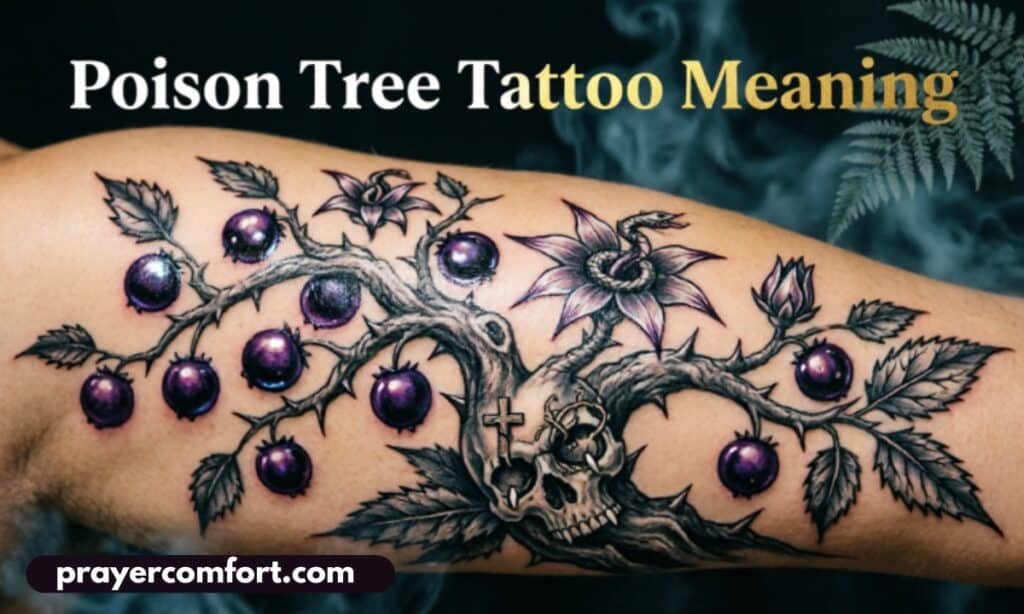
A poison tree tattoo symbolizes suppressed anger and hidden resentment that grows worse the longer it stays unspoken. It draws directly from William Blake’s 1794 poem “A Poison Tree,” in which buried wrath toward an enemy grows into a literal tree bearing a poisoned apple. In tattoo culture, it represents the idea that silence does not end conflict, it just lets it grow roots.
Click Here To Read PMO Meaning Slang
Where the Poison Tree Symbol Actually Comes From
Most people assume this is a modern gothic invention, but it has a very specific literary birthplace. Understanding that origin changes how the tattoo reads on skin.
William Blake’s Poem Started It All
William Blake wrote “A Poison Tree” as part of his 1794 collection Songs of Experience. The poem lays out two very different reactions to anger in just four short stanzas.
When the speaker gets angry at a friend, he says so, and the anger passes. When he gets angry at an enemy, he stays quiet, and that silence becomes a seed. The seed grows into a tree. The tree produces a single glowing apple. His enemy eventually eats that apple and ends up dead beneath the branches.
Blake originally titled the piece “Christian Forbearance” before switching to “A Poison Tree.” That change matters. He was not celebrating patience or restraint. He was pointing out how quietly holding a grudge can be its own quiet form of cruelty.
How a 1794 Poem Became Body Art
Literary tattoos have always had a following among readers, writers, and anyone who wants ink with more weight than a trend. Blake’s poem fits that appetite perfectly because the metaphor is visual already. A tree growing from buried emotion translates onto skin without much interpretation needed.
By the 2010s, tattoo artists specializing in dark botanical work started producing custom poison tree designs for clients describing breakups, family estrangement, and long term emotional suppression. The symbol spread through tattoo forums and portfolio pages long before it became a common search term.
What Does a Poison Tree Tattoo Symbolize
The core meaning stays consistent across most interpretations, though people layer in personal details. Common symbolic threads include:
- Suppressed anger that builds instead of fading
- Hidden resentment toward a specific person or situation
- Betrayal, whether given or received
- Toxic relationships and the damage they leave behind
- The danger of silence as a coping method
- Personal transformation after processing pain
- Self awareness about one’s own darker emotions
The design rarely means one single thing. Most people wear it as a private reminder rather than a message meant for everyone who sees it.
The Poem’s Symbolism, Broken Down
Each part of Blake’s poem maps onto a specific visual element that tattoo artists use.
The tree itself stands for anger that was never released. It grows slowly and quietly, the same way resentment builds when someone keeps smiling instead of speaking up.
The apple represents temptation and deceit. Its brightness pulls the enemy in, echoing the forbidden fruit from Genesis. That biblical connection is intentional on Blake’s part, since the whole poem plays on the idea of a fall from grace caused by hidden sin rather than open conflict.
The garden functions as the mind itself, a private space where the poison gets cultivated in secret before anyone else notices.
Tattoo artists often translate these into cracked bark for internal turmoil, thorns woven through branches for deceit, and a single glowing fruit as the focal point of the piece.
Poison Tree Tattoo vs Other Tree Tattoo Styles
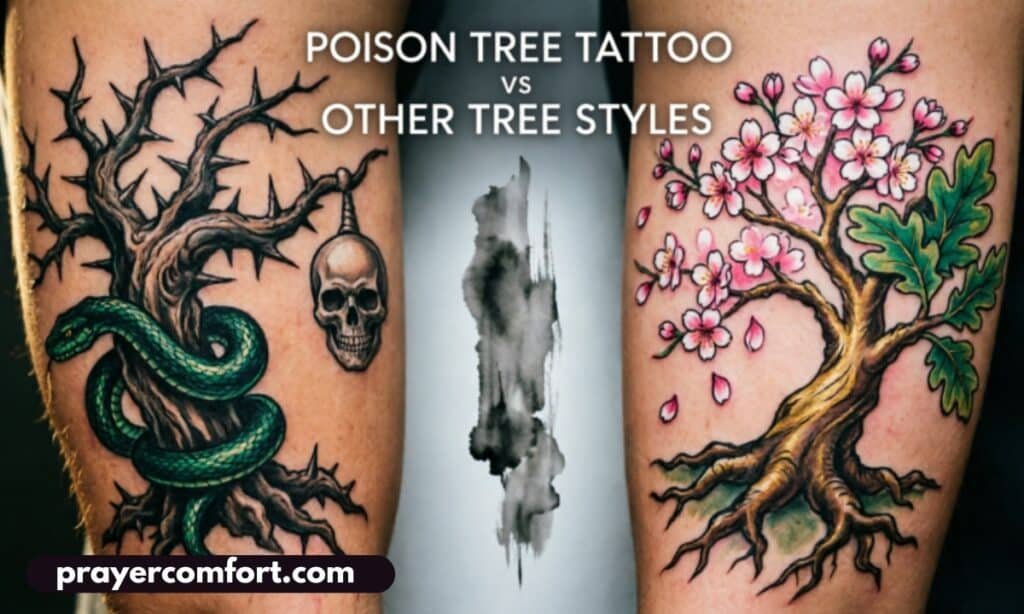
Tree tattoos as a category cover a wide range of meanings, and the poison tree stands apart from most of them. Here is how it compares.
| Tree Tattoo Type | Typical Meaning | Visual Style |
| Poison Tree | Suppressed anger, hidden resentment, emotional consequence | Twisted, cracked bark, glowing or dripping fruit, thorns |
| Oak Tree | Strength, resilience, family roots | Thick trunk, full canopy, grounded look |
| Cherry Blossom | Beauty in impermanence, renewal | Soft pink petals, delicate branches |
| Willow Tree | Grief, mourning, flexibility through hardship | Drooping branches, flowing lines |
| Tree of Life | Connection, growth, unity across generations | Symmetrical roots and branches, often circular |
| Bonsai Tree | Patience, discipline, careful cultivation | Small, controlled, sculpted shape |
Where most tree tattoos lean toward comfort or growth in a positive sense, the poison tree leans into discomfort on purpose. It is meant to feel like a warning as much as a memorial.
Who Actually Gets This Tattoo, and Why
People searching for this design tend to fall into a few overlapping groups. Some are literature lovers who want a Blake reference done in ink rather than a book quote across the collarbone.
Others come out of a specific emotional chapter. A client who spent years staying quiet through a toxic marriage, a friendship that ended in betrayal, or a family relationship built on unspoken resentment often finds this design more accurate than a generic phoenix or lotus.
A growing number of 2025 and 2026 clients are also requesting the piece as part of a “healing sleeve,” where the poison tree marks the low point of a larger story that continues into brighter botanical work further up the arm.
One Portland based tattoo studio reported in early 2026 that custom literary tattoo requests, including Blake pieces, rose noticeably among clients aged 25 to 34, a group that also drives most of the current demand for dark academia inspired ink. That pairing of poetry and personal narrative is part of what keeps this specific design from feeling like a passing trend.
Common Design Styles for a Poison Tree Tattoo
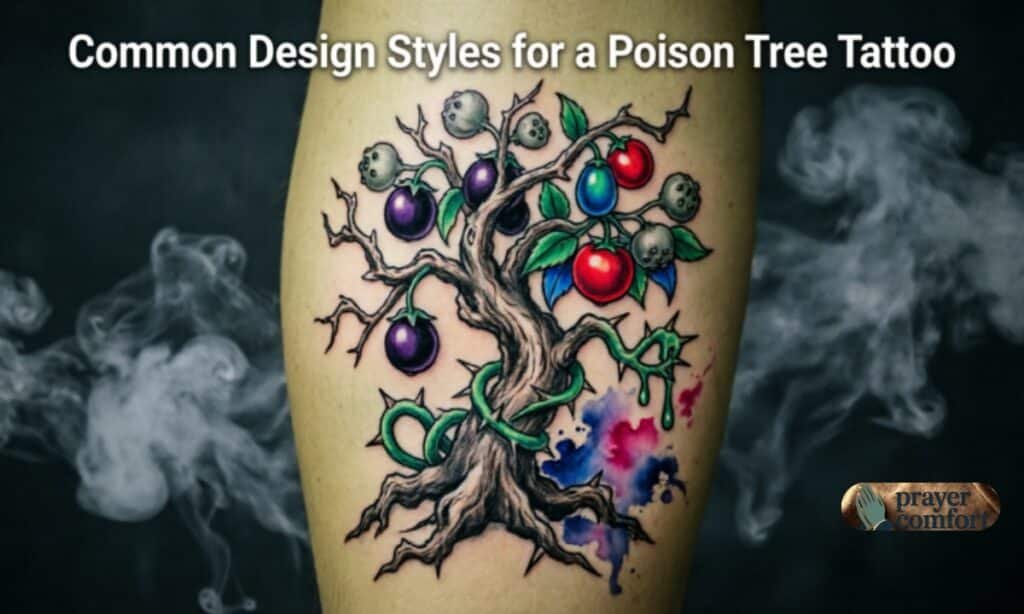
The design flexes across several tattoo styles depending on how bold or subtle someone wants the meaning to read.
- Blackwork: Heavy shading, high contrast, twisted silhouette against bare skin
- Fine line: Delicate branches and thin roots, often smaller and more private
- Neo traditional: Bold outlines, saturated color on the apple, stylized bark texture
- Illustrative: Sketch style lines that look pulled straight from a book page
- Watercolor: Softer edges with color bleeding around the fruit, less common but striking
Fine line versions have become especially popular for people who want the meaning without a large, attention grabbing piece.
Best Placement Ideas
Placement changes how personal or visible the tattoo feels, which matters for a design this emotionally loaded.
- Forearm: Visible, good for storytelling pieces with added elements
- Upper arm or shoulder: More room for detailed branches and fruit
- Back or shoulder blade: Large canvas for a full scene, easy to keep private
- Ribs or side: Intimate placement for a personal reminder rather than a display piece
- Ankle or calf: Smaller scale, works well for fine line versions
Larger placements like the back allow room for the full Blake narrative, from seed to fruit to consequence, told across one continuous piece.
Pain Level and Healing, the Honest Version
Pain depends far more on placement than on the design itself. Ribs, spine adjacent areas, and inner arms tend to rank higher on discomfort because of thin skin and nerve density.
Forearms and outer shoulders are generally more tolerable, especially for a design that relies on line work rather than heavy solid black fill. Sessions for a detailed poison tree piece, particularly larger back or sleeve versions, often run two to four hours depending on size and shading depth.
Healing follows standard tattoo aftercare. Keep the area clean, avoid direct sun for several weeks, and moisturize without soaking it. Cracked bark detail and fine root lines can lose crispness if a client skips proper aftercare in the first two weeks, so this is not a design to treat casually during healing.
How to Personalize a Poison Tree Tattoo
A generic poison tree design works fine, but most people who research the meaning deeply want something that reflects their own story.
- Add a small line from the poem, written in your own handwriting or a chosen font
- Include a date marking when a specific relationship or chapter ended
- Pair the tree with a broken chain or unlocked cage to signal moving past the resentment
- Use color sparingly, reserving it for the apple to keep the rest of the piece muted
- Add a second, healthier tree or blooming branch nearby to represent growth after the anger
- Choose roots shaped like a specific pattern meaningful to you, rather than a stock design
Artists who specialize in literary and dark botanical tattoos can usually sketch a custom version in a single consultation once they understand the personal angle behind the request.
Poison Tree Symbolism Beyond Blake
Blake’s poem is the dominant reference, but it is not the only cultural root behind poisonous tree symbolism. The upas tree of Javanese folklore was long believed to poison anything beneath its canopy, a myth later used by writers including Alexander Pushkin as a metaphor for tyranny and unchecked power.
Biblical tradition also carries its own poisoned tree, the forbidden fruit in Eden, which shares the same theme of temptation leading to consequence. Some clients blend these references intentionally, using Eden inspired imagery alongside Blake’s tree to widen the meaning beyond a single relationship and toward a broader statement about human nature.
None of this changes the primary meaning most people associate with the tattoo. It simply shows the symbol has deeper cultural roots than a single 18th century poem, which gives artists more visual language to pull from.
Things to Consider Before Getting One
A few practical points are worth thinking through before booking the appointment.
- Decide whether you want the design to be private or openly visible, since the meaning is heavy for casual conversation
- Research artists who specifically work in dark botanical or literary tattoo styles rather than a generalist
- Think about whether you want the piece to represent a closed chapter or an ongoing process
- Consider size carefully, since intricate bark and fruit detail can lose clarity if scaled too small
- Ask your artist about linework longevity, since fine line poison tree designs can fade faster than bold blackwork over the years
Frequently Asked Questions
What does a poison tree tattoo mean?
It symbolizes suppressed anger and hidden resentment that grows worse over time when left unspoken. The meaning comes directly from William Blake’s 1794 poem “A Poison Tree.”
Is the poison tree tattoo based on a real poem?
Yes. William Blake wrote “A Poison Tree” for his 1794 collection Songs of Experience, and it remains the primary literary source behind the design.
Does a poison tree tattoo have a negative meaning?
It leans dark, but most people wear it as a reminder rather than a celebration of anger. Many treat it as a symbol of the growth that came after processing hidden resentment, not the resentment itself.
Where is the best placement for a poison tree tattoo?
Forearms and shoulders work well for detailed versions, while ribs and ankles suit smaller, more private pieces. Placement usually depends on whether the wearer wants the meaning visible or kept personal.
How much does a poison tree tattoo cost?
Pricing varies by size, detail, and artist experience, but detailed pieces in this style typically run in the mid to higher range for custom work due to shading and linework complexity. A small fine line version costs considerably less than a full back piece.
Can you add color to a poison tree tattoo?
Yes, though most designs keep color minimal, often reserved for the apple, with the rest of the piece done in black and grey to preserve the somber tone.
What is the difference between a poison tree tattoo and a tree of life tattoo?
A tree of life generally symbolizes connection, unity, and growth in a positive sense. A poison tree focuses on suppressed emotion and the consequences of silence, giving it a darker, more introspective meaning.
Final Thought
If you are considering this tattoo, spend real time deciding what specific moment or relationship it represents before you sit down for the appointment.
A poison tree tattoo carries the most weight when it marks something you have actually processed, not something you are still carrying quietly, which is the exact trap the original poem warns against.

Ethan is a passionate content creator and SEO specialist with 2 years of hands-on experience in crafting compelling digital narratives.A peaceful space to find daily prayers, uplifting blessings, and spiritual inspiration to brighten your life.
