
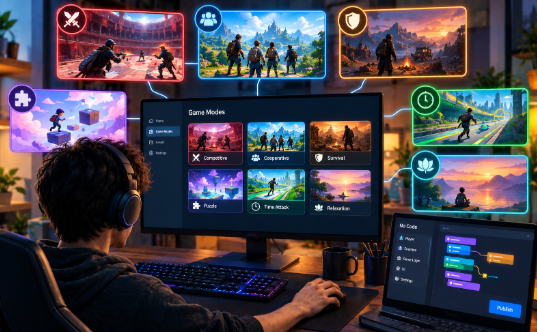
Game modes are what give games variety and extended engagement. A core game is one experience. Multiple game modes create multiple reasons to return, appeal to different play styles, invite friends to engage in different ways. Yet designing game modes used to require either building entirely separate games or massive development effort to implement variation systems. Most games shipped with a single mode or a handful of variations that felt like minimal effort additions. No-code game maker tools are changing this by making designing and implementing diverse game modes accessible, letting creators build multiple distinct modes that expand what a game actually offers. That variety transforms a single-mode game into something with far more depth and replay value, appealing to broader audiences with different motivations.
Why Game Modes Matter
A game with only one mode appeals to a narrow audience. Players seeking competitive gameplay might not care about a relaxation mode. Players wanting solo experiences might ignore multiplayer. Players seeking challenge might skip casual options. That variety means different players engage with different modes, and the same player might choose different modes depending on mood or available time.
That mode variety also extends engagement. A player who gets tired of one mode has other options to try rather than moving to a different game entirely. Someone might play competitive mode intensely for a week, then switch to relaxation mode for a change of pace, then try cooperative mode with friends. That variety within a single game keeps players engaged far longer than a single experience could.
Mode variety also creates opportunities for unique experiences. A game mode designed around specific mechanics or constraints that only exist in that mode creates novelty that keeps returning players interested. A limited-time mode with specific rules creates urgency and events that build community engagement.
How No-Code Tools Enable Mode Design
Making Mode Implementation Straightforward
Traditional development required duplicating enormous amounts of code to support multiple modes. Shared systems meant modes were variations on identical foundations. Creating genuinely distinct modes required massive development effort. No-code tools simplify this by handling the shared infrastructure automatically, letting creators focus on what makes each mode specifically different.
That automation means implementing a new mode takes hours rather than weeks. A creator describes what makes the mode unique, and the platform handles everything else. That speed makes experimenting with multiple mode concepts practical rather than something only viable with enormous resources.
Supporting Rapid Mode Iteration
Once a basic mode exists, refining it happens quickly. Adjust difficulty, change progression pacing, modify rules, test immediately. That instant feedback lets creators test dozens of variations, discovering what actually works rather than building one mode and hoping it’s engaging.
That rapid iteration is genuine because each test takes minutes rather than hours. A creator can test a mode variation, gather feedback from real players, adjust based on that feedback, and have a new version ready for testing the same day. That compressed timeline makes iterative mode design practical.
Enabling Parallel Mode Development
Since mode implementation is straightforward, designers can work on multiple modes simultaneously. Rather than committing to one mode and iterating on it, build variations of several different modes, test them all, choose the strongest ones. That parallel development produces better mode selection through direct comparison rather than sequential development where early choices constrain later options.
Providing Mode Templates and Examples
Most no-code tools include templates for common game modes. Competitive modes, cooperative modes, survival modes, puzzle modes, each has established patterns that work. Those templates aren’t limitations, they’re starting points. Creators can use templates as-is or heavily customize them to suit their vision.
Designing Engaging Game Modes
Define What Makes Each Mode Specifically Different
A game mode should have a clear identity, something that distinguishes it from other modes. Is it competitive where players battle each other? Cooperative where they work together? Relaxation where challenge is minimal? Survival where the goal is lasting as long as possible? Time attack where speed matters? That clear identity helps both creators understand what they’re building and players understand what to expect.
That identity should extend beyond rule changes. A mode isn’t just the same game with different difficulty. It’s an experience designed around specific goals and mechanics that create a distinct feel.
Balance Familiarity With Novelty
Modes should be recognizable as part of the same game, sharing core mechanics and identity. A player jumping between modes shouldn’t feel like they’re learning a different game. But modes should also offer something new. A competitive mode shouldn’t feel identical to a solo mode. A survival mode should present different challenges than standard progression.
That balance means modes feel related but distinct. Players recognize they’re playing the same game, but each mode offers something different worth experiencing.
Consider Different Play Styles and Motivations
Different modes appeal to different motivations. A competitive mode appeals to players seeking challenge and ranking. A cooperative mode appeals to players seeking social connection. A relaxation mode appeals to players seeking stress-free engagement. A puzzle mode appeals to players seeking intellectual challenge. That diversity means different players can find modes appealing to them.
Creating modes for different motivations requires understanding what actually drives engagement for different players. A competitive mode needs meaningful ranking and rewards. A cooperative mode needs smooth coordination and communication. A relaxation mode needs pacing that doesn’t pressure players. A puzzle mode needs satisfying logic.
Create Progression Within Modes
Even short-term modes should offer progression. A player should feel like they’re improving, achieving things, advancing in some way. That progression might be numerical ranking, story unlocks, cosmetic rewards, or pure skill development. Without progression, modes feel shallow and lack reasons to return.
That progression should be achievable within reasonable timeframes. A player engaging with a mode should see meaningful advancement in a single session.
Testing Modes Effectively
Watch Different Player Types Engage With Each Mode
Observe how competitive players experience competitive modes. Watch casual players in relaxation modes. See cooperative players in team modes. That targeted observation reveals whether each mode actually appeals to its intended audience and whether the mode delivers what players expect.
Identify Modes That Generate Repeat Engagement
The success metric for a game mode is whether players return to it. A mode might be fun initially but have no staying power. A mode might seem boring initially but develop depth through repeated engagement. Testing which modes players actually want to return to reveals which ones genuinely work.
Gather Feedback About Mode Identity
Ask players what makes each mode specifically different, what they prefer about it, whether it feels distinct. That feedback reveals whether mode identity comes across clearly and whether modes successfully offer different experiences or feel like variations on identical gameplay.
A Practical Example of Mode Variety
Swing Hero demonstrates what thoughtful mode design produces, distinct experiences within a single game that appeal to different play styles. The game shows how variety in modes creates engagement where a single-mode game would plateau.
Learning how to use a game maker online to design unique game modes means focusing on what makes each mode specifically different and testing whether those differences actually create distinct experiences worth returning to.
Types of Game Modes That Work Well
Competitive modes pit players against each other directly. Cooperative modes require players working together toward shared goals. Survival modes challenge players to last as long as possible. Puzzle modes focus on intellectual challenge rather than reflexes. Relaxation modes minimize pressure and time constraints. Story modes advance narrative. Challenge modes offer specific constraints or objectives. Limited-time modes create urgency and community events. That variety means there’s a mode for nearly every play style and motivation.
Common Mode Design Mistakes
Creating too many modes spreads development effort thin, resulting in modes that feel half-finished rather than modes fully realized. Creating modes too similar to each other means they don’t offer distinct experiences. Creating modes with unclear identity means players don’t understand what they’re getting into. Modes without progression lack reasons to return. Modes balanced incorrectly mean some feel too easy while others are frustratingly hard.
Final Thoughts
No-code game maker tools enable designing unique game modes by making implementation straightforward, supporting parallel mode development, and enabling rapid iteration. Define what makes each mode specifically different, balance familiarity with novelty, create modes appealing to different play styles, and build progression within modes. Test whether each mode appeals to its intended audience and whether players actually return. The result is games with variety that extends engagement, appeals to broader audiences, and creates reasons to return repeatedly.

